Madness, Miracles, Machines: Living in a Delirious World Without Walls
“A flickering brain, which relinks or creates loops—this is cinema.”1 Inspired by this quote from Gilles Deleuze, I will enter the question of the psychopathologies of cognitive capitalism through cinema and other media machines.I would like to start with the opening monologue from the film Michael Clayton (Tony Gilroy, 2007):
Michael. Dear Michael. Of course it’s you, who else could they send, who else could be trusted? I… I know it’s a long way and you’re ready to go to work… all I’m saying is wait, just wait, just-just-just… please hear me out because this is not an episode, relapse, fuck-up, it’s…I’m begging you Michael. I’m begging you. Try and make believe this is not just madness because this is not just madness.Two weeks ago I came out of the building, okay, I’m running across Sixth Avenue, there’s a car waiting, I got exactly 38 minutes to get to the airport and I’m dictating. There’s this, this panicked associate sprinting along beside me, scribbling in a notepad, and suddenly she starts screaming, and I realize we’re standing in the middle of the street, the light’s changed, there’s this wall of traffic, serious traffic speeding towards us, and I… I-I freeze, I can’t move, and I’m suddenly consumed with the overwhelming sensation that I’m covered with some sort of film. It’s in my hair, my face… it’s like a glaze… like a… a coating, and… at first I thought, oh my god, I know what this is, this is some sort of amniotic—embryonic—fluid. I’m drenched in afterbirth, I’ve-I’ve breached the chrysalis, I’ve been reborn. But then the traffic, the stampede, the cars, the trucks, the horns, the screaming and I’m thinking no-no-no-no, reset, this is not rebirth, this is some kind of giddy illusion of renewal that happens in the final moment before death. … And then I realize no-no-no, this is completely wrong because I look back at the building and I had the most stunning moment of clarity. I… I… I… I realized Michael, that I had emerged not from the doors of Kenner, Bach, and Ledeen, not through the portals of our vast and powerful law firm, but from the asshole of an organism whose sole function is to excrete the… the-the-the poison, the ammo, the defoliant necessary for other, larger, more powerful organisms to destroy the miracle of humanity. And that I had been coated in this patina of shit for the best part of my life. The stench of it and the stain of it would in all likelihood take the rest of my life to undo. And you know what I did? I took a deep cleansing breath and I set that notion aside. I tabled it. I said to myself as clear as this may be, as potent a feeling as this is, as true a thing as I believe that I have witnessed today, it must wait. It must stand the test of time. And Michael, the time is now.
These words are Arthur Edens’ (Tom Wilkinson), a top lawyer at a powerful firm that defends multinationals and other big players against law suits for biopolution and other “casualties of capitalism.” He is talking to his colleague and friend Michael Clayton (George Clooney) who is charged with bringing Edens back to reason. In the monologue, Edens describes his “insane” flash of insight: their powerful firm excretes poison into humanity. And instead of taking the usual “deep cleansing breath” and pushing this knowledge back into hidden corners of the mind, he snaps and refuses to respect the norms of hyper capitalism. This is madness as a form of political resistance, and even more fundamentally, a resistance against the destruction of “the miracle of humanity.” As Deleuze and Guattari have argued, schizophrenia, both clinical and critical, deals with the socio-political.2 So is this form of madness indeed a typical psychopathology of cognitive capitalism that we are discussing here today? Or in Giorgio Agamben’s words, is this illness an “out-of-jointness” with the demands of time that indicates what it means to be contemporary, seeing the darkness of our age?3
In my book The Neuro-Image I take Eden’s delirious intelligence as a form of what Warren Neidich calls “neuropower” or “noopolitics” characteristic of the contemporary screen culture of the digital age that is obsessed with the brain, especially in its schizoid characteristics.4 I suggest calling this new mode of cinema after Gilles Deleuze’s movement-image and time-image “the neuro-image.”5 The neuro-image is deeply indebted to Deleuze and Guattari’s schizoanalysis, and takes the delirious, hallucinatory and affective dimensions of contemporary screen culture into its neuroscientific, philosophical and political implications. While in the book I focus on the contemporary dimensions of the neuro-image, here I would like to go back in time and look at one of the original moments of modern conceptions of madness by going back to the turn of the twentieth century.
To understand our modern psychopathologies I propose to return to one of the first insightful accounts of delusional madness, Daniel Paul Schreber’s Memoirs of My Nervous Illness, published in 1903.6 Schreber’s case remains interesting to contemporary audiences for re-evaluating our own madness (and “normalities”), and for re-evaluating our relation to our bodies, brains and machines and the particular assemblages (or apparatuses) in which they are constituted.
In 2011 Simon Pummell made a film based on Schreber’s memoirs, Shock Head Soul and created a related art installation The Sputnik Effect. I will take these two works as starting points for investigating the continuities and changes in the way we conceptualise madness in relation to cultures of cognitive capitalism.I will move (quickly and with terribly big steps for which I apologize in advance) through three historical periods: starting in Schreber’s time, the turn of the twentieth century, making a pause mid-twentieth century, and ending at the turn of the twenty-first century in the “time that is now.”
Going back in time to look for the roots of our contemporary madness is also to say that while many things may change, nothing completely disappears in the “flickering” and “relinking” loops of our brain screens that are caught in an eternal return of difference and repetition.
The central assumption in my proposal is that modern conceptions of madness are fundamentally related to media machines—so the words “Modernity” and “Media” could have been tagged on to “Madness, Miracles and Machines”of the title. So media are more than representations of our world. They are fundamentally part of the psychopathological assemblages that I want to sketch out.
1900s
Let’s first turn to Schreber’s own time. Schreber wrote his autobiographical account of his mental illness in a period of many modern discoveries, in science, psychiatry but also in art, literature and in new technological communication media.In his recent book The Age of Insight Eric Kandel returns to the intellectual and artistic schools of Vienna around 1900 where he situates the beginnings of what we now have begun to call “neuroaesthetics,” the engagement of the sciences of the mind with the arts, and vice versa.7 More particularly, he focuses on the work of Vienna’s modernist portraitists Gustav Klimt, Oskar Kokoschka and Egon Schiele, the novels of Arthur Schnitzler and the Vienna School of Medicine. These Viennese artists and scientists met regularly at the salon of Bertha and Emil Zuckerkandl where they shared a new and modern interest in the inner world and the unconscious, instinctual strivings of people. Each of them developed their own ways of discovering and uncovering these inner worlds: using facial expression and hand and body gestures in their portraits, depicting a flat inward looking sensual world in their style, describing streams of consciousness in internal monologues in writing, uncovering what’s beneath the surface of the body and the skull in a fascination for biology.
Freud, too, was part of this intellectual/artistic circle. He started at the School of Medicine as a neurobiologist, but abandoned his work on the brain to focus on the mind—though he always remained keen on establishing his theory of sexuality as a science (hence his big argument and eventual break with Jung who wanted to move beyond the strict scientific references). By now, we all know the limits of Freud’s main interpretative framework around the Oedipal complex and his unique focus on sexuality, but this does not make him less important for the systematic development of new views of the human mind as irrational (unconscious drives, sexuality, aggression, inner worlds), his emphasis on self-examination (he analysed himself also on a daily basis, thirty minutes each day), and his insistence on the thin line between normal behavior and mental illness. While in his practice Freud never treated any psychotic patients (only neurotic ones, who suffer from repression rather than from delusion), these three aspects (the mind as irrational, self-examination of inner world, and the fluid borders between sanity and insanity) made Freud interested in the Schreber case. In a letter to Jung, who recommended Freud to read Schreber’s memoirs, Freud famously said that Schreber should have been made a professor of psychiatry and director of a mental hospital for the insights into the deranged mind that he provided.
As one of the first schizophrenics to write down his experiences of psychotic hallucinations and paranoid delusions from the inside out, Schreber expressed himself with extraordinary clarity. Moreover, as a judge, he took his memoirs to court to fight the decision to keep him in the asylum, arguing that he did no harm to anyone and that he could not be held against his own will for his private religious beliefs (as he called his delusions). He won the case and was released in 1902 after eight years of detention in the asylum.
Schreber thought (felt and knew) that God had chosen him to save the world. The price he paid for this was that his body was remade into that of a woman. Schreber describes how he felt every organ and bone in his body was “temporarily damaged by miracles” that transformed his body, changing his sex organ, removing the hairs of his beard one by one, crushing his rib cage and making him smaller and lighter, turning him into a woman.8 He also felt he was becoming the rays of the sun, and God spoke to him as the sun from the future. At the same time he felt persecuted by God’s all knowingness.
In his 1911 analysis based on Schreber’s memoirs, Freud focuses on Schreber’s obsessive relation to doctor Flechsig, the head of the asylum.9 Freud interprets his delusions as repressed homosexuality, related to Schreber’s father, a well-known educationalist “from hell” who invented all kind of machines such as the “Geradehalter” and the “Kopfhalter” to discipline children and make them sit straight that were very popular at the time. Schreber’s arrested libido, according to Freud, expresses itself as paranoid megalomania. The sun is according to Freud a sublimated father symbol. Freud’s insistence on childhood traumas that influence the psyche is still relevant today; and, as Colin MacCabe indicates, his insistence on repressed homosexuality might also have been related to the “coming out” of homosexual desire across Europe. So it might have been more of a socio-political problem than Freud’s theory of sexuality acknowledged.
But I do not want to spend much time on the merits and limits of Freud’s analysis. I just want to indicate the context of the emergence of modern forms of madness that was related to an interest in the psychodynamics of modern man that also seemed to be profoundly connected to mediating machines. Let’s go beyond the Freudian interpretation and return to the Schreber case to see how all of this played out there.10
Influencing Machines
Schreber’s God had a controlling system at his disposal that he called the writing-down machine, a machine that captured in words everything Schreber ever thought, said or did, even everything that was ever said or thought by any one in any language of the world. At the same time this writing-down machine connected him to God in a divine and cosmic way. This controlling power of machines seems very specific for schizophrenia. In 1919 one of Freud’s students, Victor Tausk, wrote a famous article in which he describes a “Beeinflussungsapparat” (“influencing machine”) that is often at the heart of paranoid delusions as a mind controlling device in schizophrenic patients.11 These machines seem to be modelled on the many media apparatuses that have their origin in Schreber’s time: wireless telegraph, photo camera, telephone, “electrical telescope” (leading to the first television transmissions), radio and the cinematograph are all modern media machines that seemed to have magical powers.
The invention and popularisation of these machines seem to be related to the emergence and definition of schizophrenia, which did not exist as mental disorder before Kraeplin and Bleuler described its symptoms in the late nineteenth and early twentieth centuries.12 As John Durham Peters argues: “With voices vanishing into the void or echoing forever, thoughts and pictures being implanted in or extracted from heads, voices commenting on actions, and ‘influencing machines’ exercising remote control over bodies, psychotic delusions constitute a shadow history of electrical communications in the twentieth century.”13
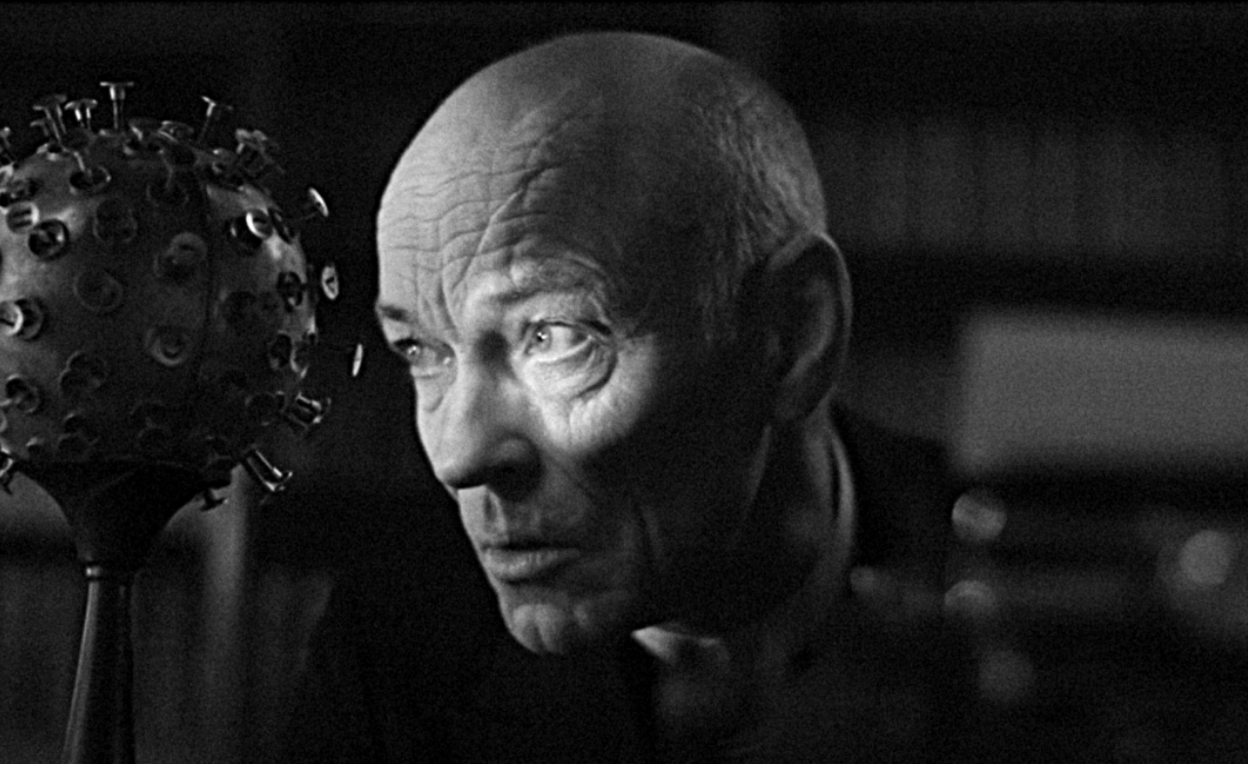
The technological machine that inspired Schreber’s delusion was informed by early typing machines, such as the writing ball by Rasmus Malling-Hansen, patented in 1870 as the first commercially produced typing machine that was sold around the world. In Simon Pummell’s Schreber film Shock Head Soul, this machine has an important role.14 Pummell combines documentary style, drama and computer animation that are subtly blended to give expression to Schreber’s delusional world. In the documentary scenes psychiatrists, media historians and scientists comment on Schreber’s case.
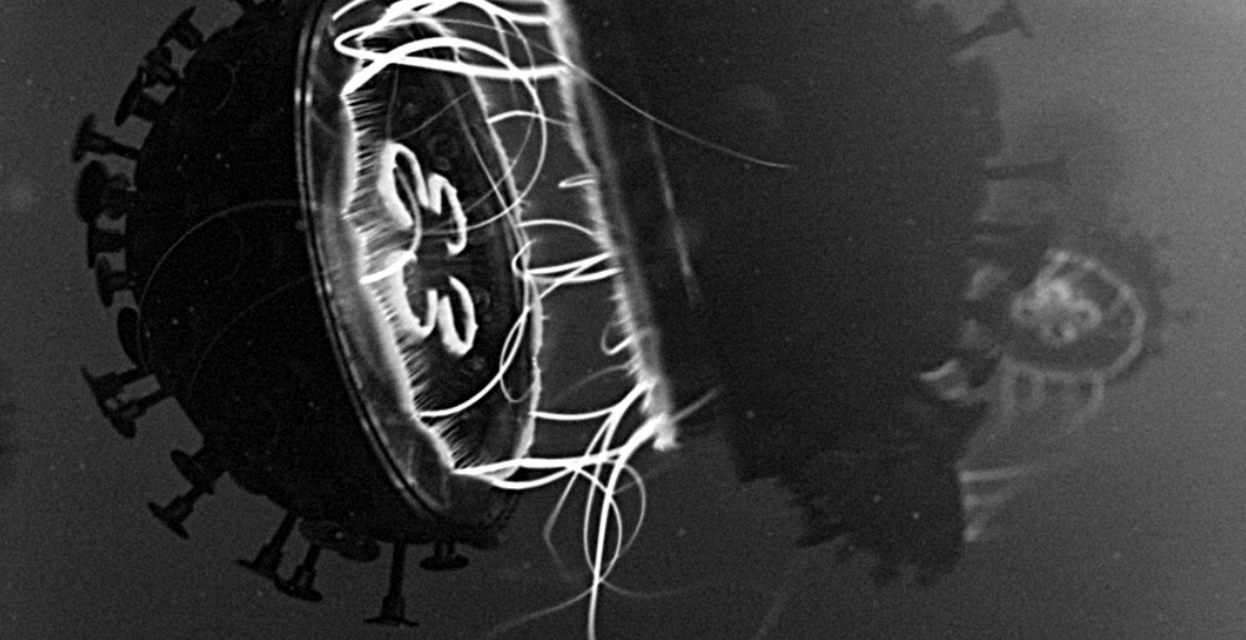
Dressed in nineteenth century outfits they speak with contemporary knowledge about Schreber’s time. In the fiction parts we see Schreber (played by Hugo Koolschijn) with his wife (Anniek Pheifer), the lonely Schreber in the asylum, and Schreber writing his memoirs. In these dramatized scenes the writing-down machine takes the form of a typewriting ball that seems organic, has somehow magically come alive, the letters on the ball slowly moving up and down (see FIG. 1). Gradually the writing ball multiplies and in a delusional, fully animated sequence these writing-down machines start to float in space, burst open and become like jellyfish with electric tentacles. In this way the film gives expression to Schreber’s description of the dissolving of his body into rays “tying to celestial bodies” connected to the powerful divine writing-down-system:
I cannot say with certainty who does the writing down. As I cannot imagine God’s omnipotence lacks all intelligence, I presume that the writing-down is done by creatures given human shape on distant celestial bodies after the manner of the fleeting-improvised-men, but lacking all intelligence; their hands are led automatically, as it were, by passing rays for the purpose of making them write-down, so that later rays can again look at what has been written.15
Shock Head Soul gives a modern account of Schreber’s pathology as a sort of omnipotent surveillance system avant la lettre. Neurological explanations of Schreber’s condition are given by one of the scientists. As are other explanations that go beyond Freud’s famous interpretation mentioned earlier. Besides the traumatic role of the father, there is also the fact that his beloved wife had a sixth miscarriage just before Schreber became psychotic. His psychosis also coincided with his appointment as judge at the high court, which would have given him a tremendous responsibility and power. Most importantly, we see in Shock Head Soul how particular machines (a typewriter ball) and particular modern knowledge (about the brain and the nervous system) get transformed into a delusion: the world emanating from God as one big neural network, mediated by the writing down machine.
In this way Shock Head Soul adds a new layer to the modernity of Schreber’s madness, extending the path indicated by Freud. Schreber does not only react to his father’s influence: he is also fundamentally dis/connected from/to his time, resisting the authority of the law, and connecting to the miraculous powers of new media machines, wanting to save the world by the miracle of his sacrifice of torturing persecution by the writing down machine that turns him into a woman and dissolves his body and mind into rays of the sun. Schreber as “the mother of all radioheads” presents us a “distorting mirror of the world of early wireless” and is therefore profoundly dis/connected from/to the modernity of his time.16
1950s
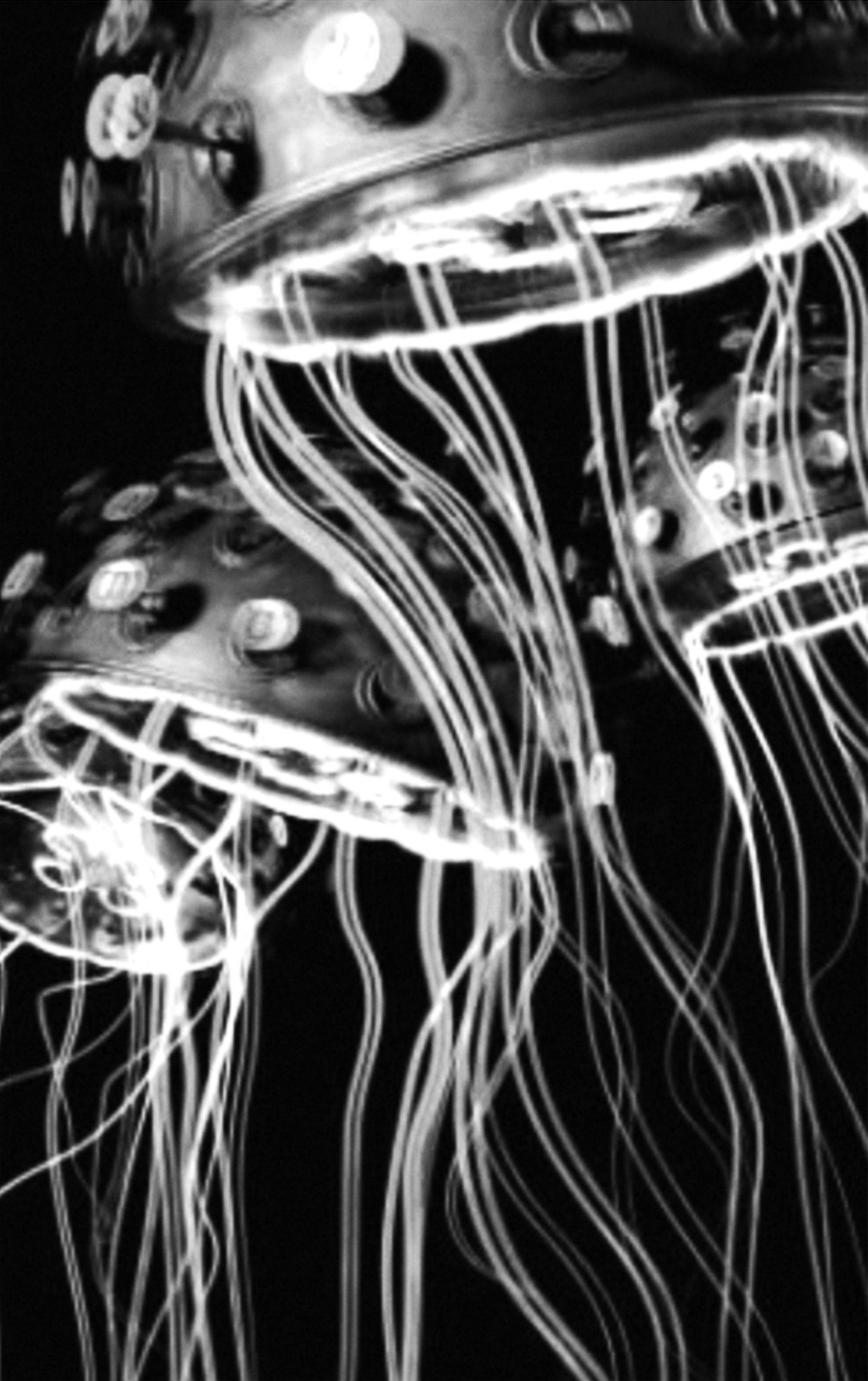
This modern view on madness and schizophrenia as related to influencing and controlling media machines found another form in the mid-twentieth century. While at the turn of the century the telegraph, radio, telephone, cinematograph, and typewriter were sources of paranoid delusions, by the fifties television and the first satellite, the Sputnik, start to manifest themselves in psychiatric disorders.17 In his installation The Sputnik Effect that he made in connection to the Schreber case in Shock Head Soul, Pummell addresses this Sputnik-related madness when immediately after its launch psychiatric patients started to report on receiving secret messages from the Russian satellite. The installation presents a whole series of variations on the writing-down-balls that appear in the animated sequences in the film, this time photographed and filmed in green-red 3-D technology, which immerses visitors of the exhibition in a 1950s delirious environment. The messages “from God” are now sent from the implied satellite, which is no less a controlling and influencing machine than the writing ball, determined by new technical and political circumstances. So we see here madness in a new historical condition, in relation to new machines and a different apparatus of power.18
Besides the Sputnik, the other powerful machine of the 1950s and 1960s obviously was the television. During this period broadcast metaphors become standard in the psychiatric diagnosis of schizophrenia. “Thought broadcasting” becomes a symptom of the delusional mind. As Peters in “Broadcasting and Schizophrenia” explains, thought broadcasting can mean that one’s thoughts are being sent abroad from a leaky brain like a broadcast transmission for all to hear. Less metaphorically—and quite literally—it usually means that actual radio and television stations serve as occult dispersers of one’s thought. Or vice versa, that the television screen sends direct messages to the viewer, commenting on actions or thoughts of the schizophrenic patient, or sometimes giving direct orders. One version of “thought broadcasting” takes the private (thought) as public (broadcasting), the other version takes the public (broadcasting) as private (thought). The delusional mind, shows us the psychotic core of modern media technology in which “faces and voices, sounds and images fly invisible through the air in an overlapping jumble of channels.”19
It is in this sense that schizophrenics show us a profound truth of a media technology saturated world. As Peters comments:
To imagine thought broadcasting as a pathology at all requires us to assume that thoughts are private property enclosed in heads that are opaque to other people. While there are clearly organic factors in mental illness, there is also clearly something quite insane in our culture’s supposition that communication should be personal mental sharing. Perhaps schizophrenics are not the ones who violate the ideal of communication as the sharing of thoughts; they are the ones who take it most seriously. They show us what it would be to live in a delirious world without walls.20
Having no protective filter against the demands of each era, and in this sense being “out-of-joint,” the schizoid mind sheds a deep and dark light on its particular media dimensions. Moreover, the particular “insane” connections that the satellite and television provoked also have to be seen in both the context of the Cold War and scientific developments, particularly the popularity of behaviorism in psychology. The Sputnik created a true mania and huge anxiety among ordinary Americans, related to the fear of the “Red Menace” and the communist intrusion. And this political fear resonated with certain ideas about mind control in science, the famous stimulus-response experiments by Skinner.21 Skinner took the scientific ideas on conditioning human behavior that were developed around the turn of the century by Ivan Pavlov and John Watson to a more radical level. So the idea of mind control, the political situation and the particular machines of the time form again an assemblage that co-created certain pathological reactions.
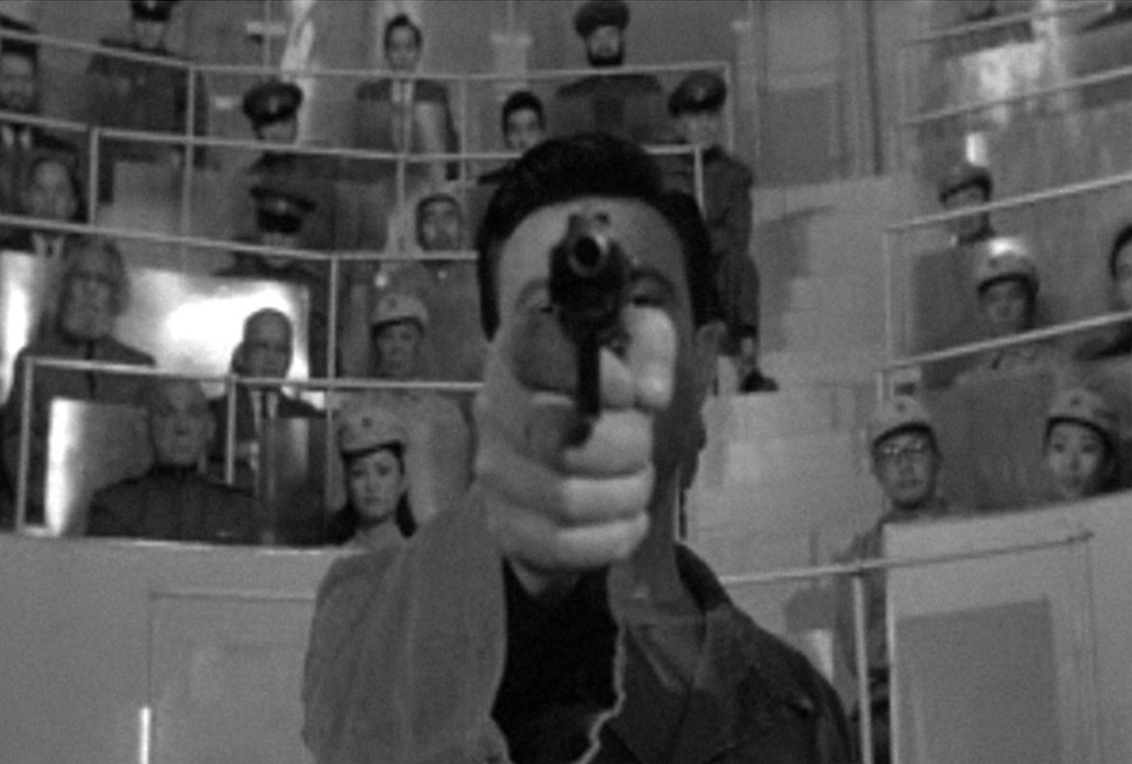
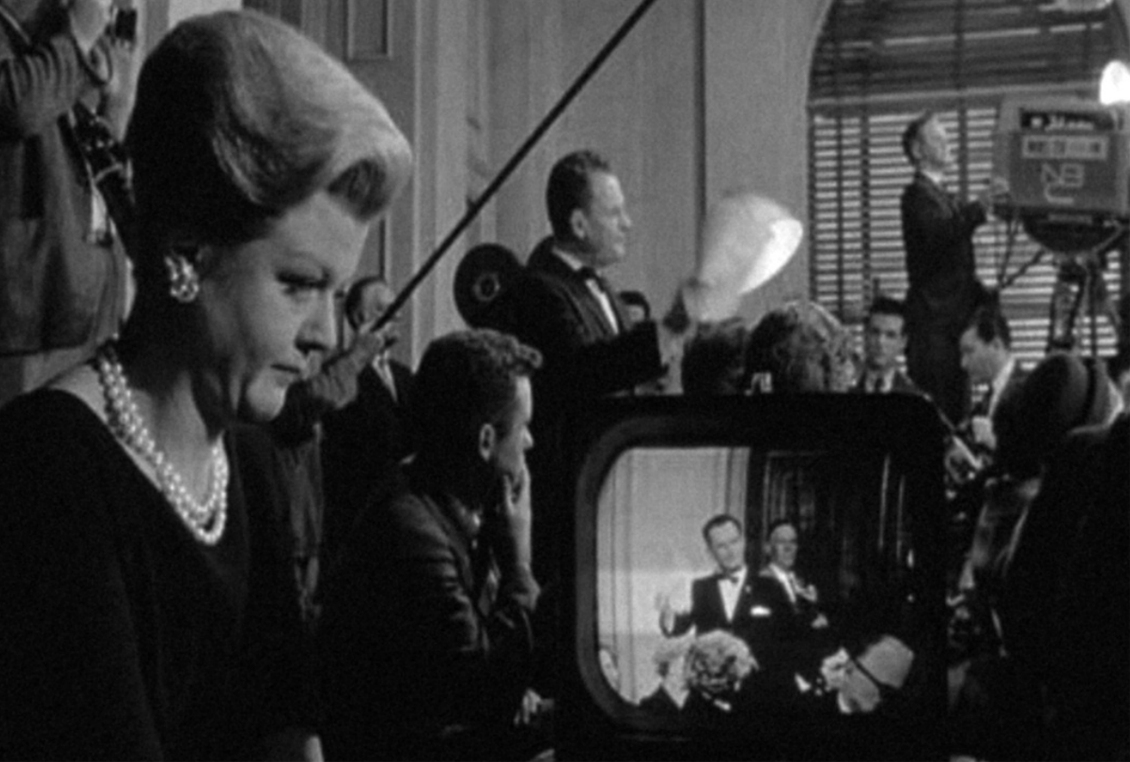
The Manchurian Candidate (John Frankenheimer, 1962) is one of the films of the mid-century that brings many of these concerns together. The story begins in 1952 during the Korean War when sergeant Raymond Shaw (Laurence Harvey) is captured by communists and is brainwashed at the Pavlov Institute in Moscow. He is sent back home to the US to be used as a sleeper agent and assassin who is subconsciously activated by seeing the Queen of Diamonds playing card.
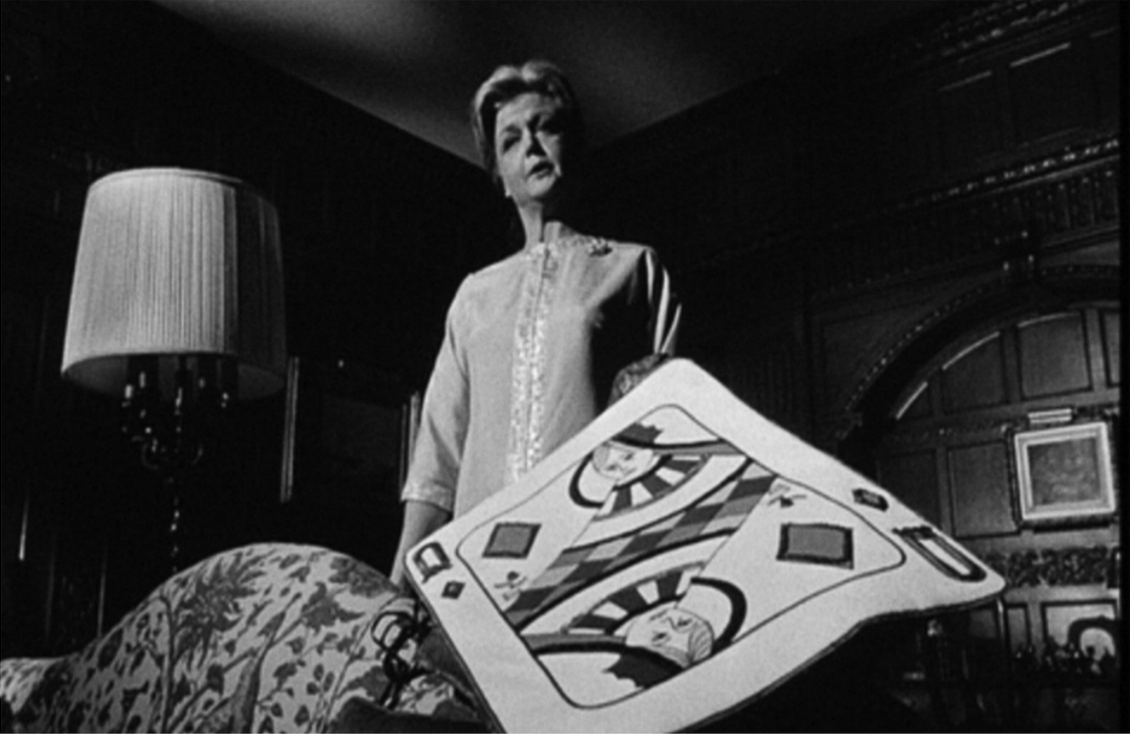
The film relates to all the ideas on mind control and political anxiety of the time. It is also a very Freudian film; “the plague” that Freud (as he famously called it himself) brought to the States in 1909 was still very much around in the 1950s and early 1960s and can be traced in countless classical Hollywood films.The central “influencing machine” in this film is the main character’s mother who controls the television image of her husband who runs for presidency. But clearly in Frankenheimer’s film the sputnik and the television as influencing “thought broadcasters” and mind controllers play an important role in the film, reflecting in this way the conditioned “homo pavlovius” of the Cold War and the particular media machines of the time.22
The Divided Self
Around the same time very different views on psychopathologies emerge, as counter-movement against the dominant ideas of conditioning and mind controlling television and satellite. R.D. Laing’s famous study The Divided Self has played an important role in the anti-psychiatry movement and the development of new views on madness that want to find ways of escaping the control of both family and cold war society.23 Stanley Kubrick’s A Clockwork Orange (1971) and Milos Forman’s One Flew over the Cuckoo’s Nest (1975) could be mentioned here as signs of time as they are films that express critiques to behaviourist conditioning and institutionalized practices that are part of these development in views on psychopathologies. Laing’s patients that he describes in The Divided Self also suffer from persecutions: “There is a plot on foot to steal his brains.”
A machine concealed in the walls of his bedroom which emitsraysto soften his brain, or to send electric shocks through him while he is asleep. The person I am describing feels persecuted by reality itself.”24 Part of that reality is the controlling machine. And, Laing argues, as a reaction to this persecution, the person becomes a vacuum, divides itself from the world, splits itself up into a dead inner self and an acting body that functions as an empty shell out of protection. Many of the patients that Laing describes report dreams where they are in the back seat of a car or a bus that is driving itself.
Besides the controlling machines (of family, social and political power relations), there is also a shared impression that the whole body becomes machinic. Laing quotes Norbert Wiener who says: “at some stage a machine which was previously assembled in an all over manner may find its connexions divided into partial assemblies with a higher or lower degree of independence.”25 Laing’s patients feel split and fragmented into different assemblages or partialsystemsthat are incoherently reassembled. It is no coincidence that Deleuze and Guattari in Anti-Oedipus refer often to Laing when they describe their less clinical and more critical or strategic schizoanalytic philosophy in their two books on capitalism and schizophrenia. Their concept of the Body without Organs, for instance, is precisely a body that loses its habitual organic coherence and becomes a machinic assemblage that triesto escape the “normal” confinements of the organism. This Body without Organs as schizoid strategy can be deadly, catatonic or too full of intensities. Or it can be creative.26 So “schizoid” strategies can be said to be both dangerous and necessary, but really the only options we have in order to deal with the (late) capitalist media world. In a similar vein, in After the Future, Bifo argues that in the age of information abundance (“semio-capitalism”) chaos, depression and other “psycho-bombs of cognitive capitalism” not only cause depression and “fog” but also an “infinity of colors, dazzling lights, hyperspeed intuitions and breathtaking emotions. Chaos is the enemy but it can also be your best friend.”27 And therefore it can also function as a defence against the madness of capitalism that increasingly plays on our brain screen. So here we see emerging more explicitly the idea (both in psychiatry and in philosophy in the work of Deleuze and Guattari and contemporary thinkers such as Bifo) that insanity, schizophrenia or the schizoid mind can be a form of “mad but lucid” insight into and resistance against the contemporary world.
2000s
The modernity of schizophrenia as a neuropathological form of madness that is fundamentally related to the modern mediated machinic world finds thus its incipience at the end of the nineteenth century when the invention of all kinds of media apparatuses provoked new ways of thinking about communication, transmission and connections of bodies, thoughts and feelings. It is possible to argue that Schreber, in his lucid delusions, foresaw the huge possibilities of the “typewriter” once it would be connected to a larger communications network. And if in the 1950s the Sputnik inspired further and new forms ofsurveillance and control, connected to the Cold War politics, the numerous satellites that circulate our orbit today potentially intensify this controlling effect. On the other hand it could be argued that the broadcasting connection to machines (related to radio and television) today no longer inspire the same schizophrenic logic. After all, today people can broadcast themselves, twitter their thoughts, accumulate hundreds of “friends” in social networking sites; it is possible to talk in public spaces with an invisible partner without being carried to the madhouse. So, as Peters argues, one way of looking at the contemporary situation is to say that there is no more ground for the schizo-pathologies I have just described for the mid-century.28
But it is just as well possible to argue that the world has thus become completely schizoid. In earlier conceptions of madness there was always a moment where the mad realizes he/she is “mad” and has to return to normality: Schreber writes his memoirs after his recovery, the Manchurian candidate becomes conscious of his manipulated subconscious and breaks the spell, in many classic films of the mad woman (in the so-called gothic genre) it always turns out that she was wrong in her suspicion.29 But today many of the delirious implications of media machines have become reality: in many ways we quite literally live in a delirious world without walls. And therefore the confrontation with new forms of madness remains important to give us insights “against all odds.” Where Schreber was fighting a fight for his personal right to madness as his own private beliefs, in the fifties madness was clearly much more related to the larger political setting of the Cold War. And so now the question is: what does “sanity and insanity” mean today? What Schreber already showed us, and what Laing, Deleuze and Guattari have elaborated more politi- cally, is that madness can be form of resistance against unbearable structures of life, both private and collective (geopolitical) life. And that, paradoxically, the confrontation with madness expresses a belief in the world, a desire to reconnect to a belief in the world. In Shock Head Soul, one of the most touching elements is the love between Schreber and his wife that remains, and despite all the despair transpires through the images. Returning to Michael Clayton, we can now see that, although part of Arthur Edens’ madness remains neurological, there is a deep social truth in his delirium.
One must be mad to break through the screens and media machines of contemporary corporate capitalism. One must be mad to resist, while being completely implicated, from within the system. There is no safe and objective moral position from which to judge. As Edens, surrounded by countless city screens and many other technological devices at display in the film experiences, resisting is a mad and individual act, but deeply connected to the collective, to the socio-political.
Homeland
Something similar can be said about the modern madness of Carrie Mathison (Claire Danes) in the television series Homeland (Showtime, 2011-). As a CIA agent in counterterrorism she is the only one who does not believe sergeant Nicholas Brody (Damian Lewis) who returns from Iraq after several years of imprisonment to be a hero.30 In fact, Brody could be considered as a contemporary “Manchurian candidate.” However, there are telling differences that might give insight into contemporary psychopathological mechanisms. Where in the 1962 film the returning war hero was manipulated by an external mind controlling device (be it the Sputnik or the Pavlov Institute of behaviorism), Brody seems to have made a more or less conscious choice—in a very different political (and “noopowered”) environment of terrorism, counter-terrorism, and contemporary findings about the brain as a complex embodied and embedded system.
In any case he is not simply hypnotized but has developed an emotional connection to his enemy. He converted to Islam, developed a bond with Abu Nazir (Navid Negahban), one of the Al Qaeda leaders and grieved over the loss of Nazir’s son by an American drone attack. All this made him see and feel from the other side, and much of the suspense in Homeland is based on his double and conflicting allegiances that cross any traditional Good-Bad opposition.
But even more interestingly the person who discovers the Manchurian candidate’s madness also has a different mind-set. Major Ben Marco (Frank Sinatra) in the Manchurian Candidate has a nightmare, a dream that puts him on the undisputed discovery trail of sergeant Shaw’s brainwashing. Carrie Mathison in Homeland on the other hand is a manic-depressive (which is partly related to a Post-Traumatic Stress Syndrome from her war experiences during the Iraq War, and partly to a hereditary condition from her father). She is on anti-psychotic medication and her judgment is always questioned by most of her CIA superiors, to the point where she is really declared mad at the end of Season One. Even though she undergoes electric shock therapy (again out of her own will, no involuntary Cuckoo’s Nest situations), it is highly significant that in Season Two the narrative seems to acknowledge the revelatory powers of her insane insights. Moreover, unlike the transcendental moral superiority of 24 agent Jack Bauer, the Homeland agent is more immanently connected to the case, developing a confusing bond to her “object of investigation” that starts the moment she has to investigate him. Before she meets Brody, she has seen him on televised images and especially on the surveillance screens of hidden cameras in Brody’s private house that she watches in her private home. Contemporary madness seems to be a truly insane and affective engagement with the world.

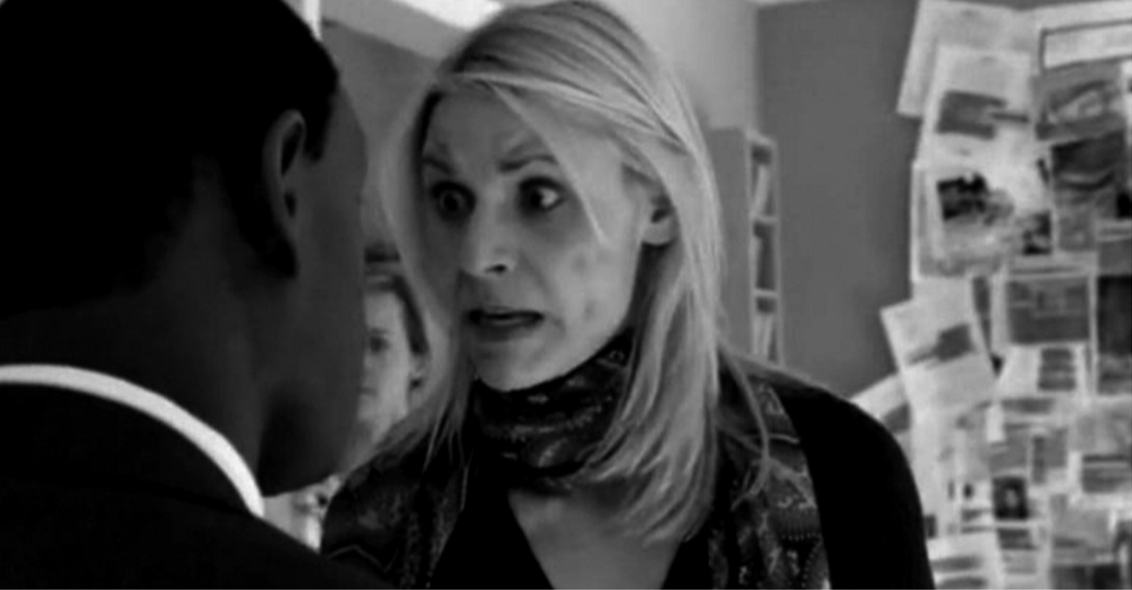
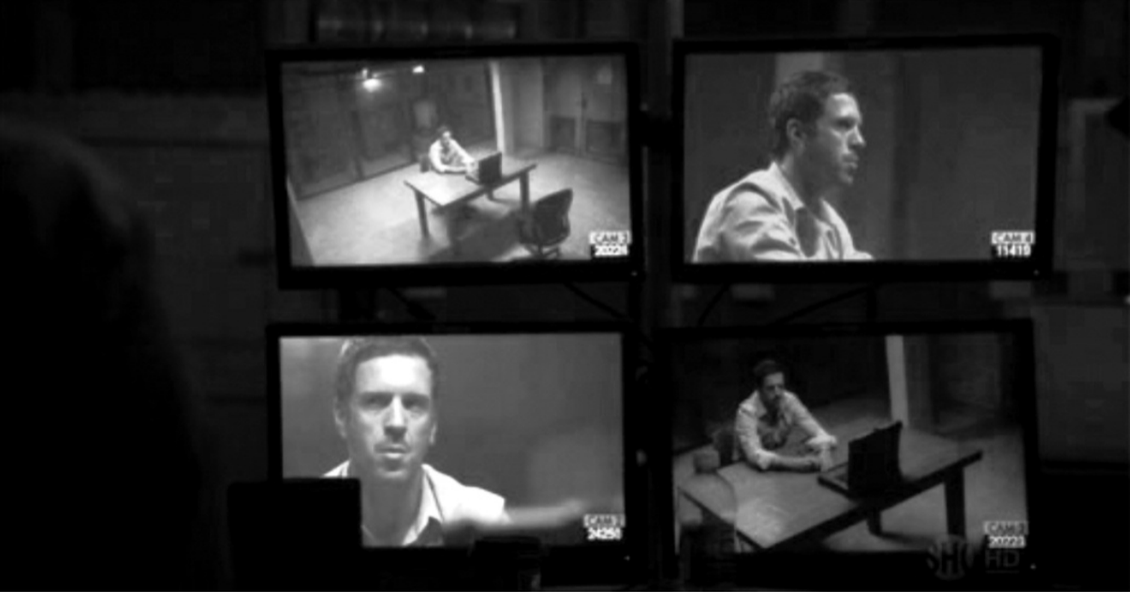
The opening credits are very telling about the ambiguity of those borders between the personal and the collective, the sane and the insane.31 The sequence is composed of fragmented shots, in black and white, overlaid with color flashes. We see a small blond girl (Carrie) sleeping. Eerie and mesmerizing jazz music accompanies the images, intercut with audio fragments of the voice of Ronald Reagan’s 1986 speech announcing an attack on Qaddafi facilities, while the image flashes to other scenes: the girl sitting on the floor in front of a television screen, while we hear a radio voice announcing the Lockerbie crash that happened in 1988. While the jazz music continues, we see the girl practicing her trumpet in her bedroom, then Louis Armstrong plays the trumpet. The next moment the girl stands in a labyrinth wearing a lion mask. Images of television addresses by George Bush, Sr., Bill Clinton and Colin Powell. We also hear the voice of George W. Bush. “This was an act of terrorism” (Clinton’s words) is clearly audible among in all the sea of aural announcements that merge with news images, veiled women, people running in New York City. Then the girl is older, looking into the camera, a television screen of Obama, first upside down, than adjusted, addressing the nation: “We must, we will remain vigilant around the clock.” Airport surveillance images. Arabic voices. The labyrinth again, where Brody appears. Brody and Carrie each at a different place in the labyrinth. Then she is running in an Arab street, headscarf and cell phone. Carrie’s eye opening in close-up. Her voice: “I missed something that day, I won’t, I can’t miss it again.”Another voice: “It was ten years ago, everyone’s missed something that day.” And Carrie’s voice” “Everyone’s not me.” Carrie listening and watching surveillance material. Brody watching the White House. Helicopters. The image and sounds are abruptly cut.
As the above description of the opening credits shows, the influence of the broadcasting screens still seems to be very relevant in the twenty-first century. But in combination with all the different screens that we have today (surveillance camera’s, mobile screens, all networked in complex and hard to grasp ways invading both private and public space) there is less One Manipulating Machine as we saw in the previous historical periods of modernity. It is the network, the “flickering machines and screens”, which “create loops that become our brains” and that show us the volatile and complex psychopathological dimensions of cognitive capitalism.
So when Simon Pummell returns to the Schreber case in Shock Head Soul, it is to rediscover the hidden truths in his account of modern madness in its relation to machines. While the Freudian interpretation that made his case famous may have lost some of its force, the power of communicating machines, and the combination of individual circumstances and world political concerns (not yet so strongly politicised in Schreber’s account) have found new translations throughout the history of science and media technology and moved into the in the age of cognitive capitalism with particular insight force. While Schreber seemed megalomaniacal and very alone in his miraculous saving of the world, contemporary psychopathologies, in all the loneliness they still imply, seem to have a much more grounded insane mission: seeing through the smoke screens of capitalism, restoring a belief in the world in order to save the miracle of humanity. And as we know from Deleuze, in cinema as elsewhere, this implies a confrontation with madness.32
Being contemporary therefore implies this confrontation with the particularly “mediated” forms of madness of cognitive capitalism. There is something beautiful and tragic about this insane contemporaneity. As Agamben argues, it is “a question of courage, because it means being able not only to firmly fix your gaze on the darkness of the epoch, but also to perceive in this darkness a light that, while directed forward us, infinitely distances itself from us. It is like being on time for an appointment that one cannot but miss.”33 When after the broadcasting of a suicide video in Homeland the world finally believes that Brody is not a hero but a terrorist, Carrie sees things yet again differently. But who would believe her in a media-saturated world that operates its own mad and maddening logic? Perhaps Schreber was right. Perhaps we need a miracle indeed.
- Gilles Deleuze, Cinema 2: The Time-Image, trans. Hugh Tomlinson and Robert Galeta (London: The Athlone Press, 1989), 215.
- Gilles Deleuze and Félix Guattari, Anti-Oedipus: Capitalism and Schizophrenia, trans. Robert Hurley, Mark Seem, and Helen R. Lane (London: The Athlone Press, 1984) and Gilles Deleuze and Félix Guattari, A Thousand Plateaus: Capitalism and Schizophrenia (London: The Athlone Press, 1988).
- Giorgio Agamben, What is an Apparatus? And Other Essays, trans. David Kishik and Stefan Pedatella (Stanford: Stanford University Press, 2009), 40.
- Warren Neidich, “Neuropower,” Atlantica Magazine of Art and Thought 48/49 (2009): 119-64, 123 and Deborah Hauptmann and Warren Neidich, eds., Cognitive Architecture: From Bio-Politics to
Noo-Politics (Rotterdam: 010 Publishers, 2010). - Patricia Pisters, The Neuro-Image: A Deleuzian Film-Philosophy of Digital Screen Culture (Stanford: Stanford University Press, 2012).
- Daniel Paul Schreber, Memoirs of My Nervous Illness, trans. and eds. Ida Macalpine and Richard A. Hunter (New York: New York Review Books, 2000).
- Eric R. Kandel, The Age of Insight: The Quest to Understand the Unconscious in Art, Mind and Brain, From Vienna 1900 to the Present (New York: Random House, 2012).
- Schreber, Memoirs of My Nervous Illness, 141.
- Sigmund Freud, The Schreber Case, trans. Andrew Webber and introduction by Colin MacCabe (New York: Penguin, 2002).
- Colin MacCabe in Freud, The Schreber Case.
- Viktor Tausk, “On the Origins of the ‘Influencing Machine’ in Schizophrenia,” Psychoanalytic Quarterly, no. 2 (1919): 519-556.
- Emil Kraeplin, Psychiatrie: Ein Lehrbuch für Studernde und Aertze (Leipzig: Johann Ambrosius Barth, 1899) and Eugene Bleuler, Dementia Praecox oder Gruppe der Schizophrenia (Leipzig: Deuticke, 1911). See for the link between magic and scientific engineering around the invention of television also Stefan Andriopoulos, “Psychic Television,” Critical Inquiry 31 (Spring 2005): 618-637.
- John Durham Peters, “Broadcasting and Schizophrenia,” Media, Culture and Society no.32, 1 (2010): 132. See also Friedrich Kittler, “Der Gott der Ohren” in Technische Schriften (1984): 130-148.
- See also www.shockheadsoul.com
- Schreber, Memoir of My Nervous Illness, 123.
- Peters, “Broadcasting and Schizophrenia,” 132.
- See also David Hoffman’s documentary Sputnik Mania (2007) http://www.sputnikmania.com
- Michel Foucault, Madness, The Invention of an Idea, trans. Alan Sheridan (New York: Harper & Row, 1976).
- Peters, “Broadcasting and Schizophrenia,” 133.
- Peters, “Broadcasting and Schizophrenia,” 136.
- See for instance, Burrhus Frederic Skinner, Science and Human Behavior (New York: The Free Press, 1953).
- Andreas Killen, “Homo Pavlovius: Cinema, Conditioning and the Cold War Subject,” in Grey Room 45 (Fall 2011): 43. This issue of Grey Room is a special issue on The Manchurian Candidate, entitled On Brainwashing: Mind Control, Media and Warfare, eds. Andreas Killen and Stefan Andriopoulos.
- Ronald David Laing, The Divided Self: An Existential Study in Sanity and Madness (London etc.: Penguin, 1965). See also the episode on R.D. Laing in documentary The Trap (Adam Curtis, 2007) http://www.youtube.com/watch?v=U8-UT3-0_Ms
- Laing, The Divided Self, 79-80.
- Laing, The Divided Self, 195.
- See for instance, Deleuze and Guattari, “How Do You Make Yourself a Body Without Organs?” in A Thousand Plateaus, 149-166.
- Franco “Bifo” Berardi, After the Future, trans. Arianna Bove, Melinda Cooper, Erik Empson, Enrico Mecchia, and Tiziana Terranova, eds. Gary Genosko and Nick Thoburn (Edinburgh, Oakland, Baltimore: AK Press, 2011), 6 and 160.
- Peters, Broadcasting and Schizophrenia, 138.
- See for instance Mary Ann Doane, The Desire to Desire: The Woman’s Film of the 1940s (Bloomington: Indiana University Press, 1987) for interesting analyses on classic films in this genre such as Caught (Max Ophüls, 1949) and Rebecca (Alfred Hitchcock, 1939).
- See http://www.sho.com/sho/homeland/home
- See the opening credits at http://vimeo.com/37322770
- Deleuze, Cinema 2: The Time-Image, 201.
- Agamben, What is an Apparatus?, 46