Mental Quilombos in the Production of Value: Flights and Counter-forms of Mania Under Cognitive Capitalism in a Postcolonial World.
Does Exit Triumph Over Voice in Producing Necessarily Psychosis?
Flight, exodus, secession have represented alternative tactics of dependent labor refusing domination as well as exploitation to voice solutions in antagonism, what Hirschman had called “exit solutions” (Hirschman 1970). The constitution of a revolutionary subject since Renaissance has shown that melancholia appears each time after various types of hopes of a radical transformation of society have been defeated. Bipolarity of the mood is frequent and produces a mix of alternative and successive hysterical political collective feelings of, on the one hand, superpower, and on the other, a floating depression.
Under the regime of cognitive capitalism, that is increasingly investing, involving and exploiting all the brain, how is this old dialectic of the subject renewed? In order to understand this very peculiar form of pathology of the mind, we propose to draw a parallel between the historical experience of Quilombos of the slaves1, a typically postcolonial revisit of the fight between the master and the slave, and the Web utilizing the declaration of Independence of James Barlow to make the argument. What are the conditions for a mental Quilombo that would create a sustainable TAZ [Temporary Autonomous Zones, as delineated by Hakim Bey]?
I shall explore the following points. In the first part, I will examine how Melancholia has replaced the antic and medieval Acedia and what Gordian Knot has woven a thread between Melanchton and Dürer on the one hand, and Benjamin and Althusser, on the other. In the second part we take the example of a true historical secession–after that of the Roman plebs–when the runaway slaves in Brazil create a real utopia and revivify the old commons that Enclosures had just destroyed in Europe. Then I will ask what about the future of the new Commons through a short examination of the contemporary forms of Quilombos. The third part is dedicated to some of the main features of trade in the new primitive accumulation of third capitalism: raiders, privateers, pirates. In the fourth part and conclusion, we will isolate what characterizes the succinct conditions of cognitive capitalism: the capture of intangibles hard to codify, to enlighten what are the conditions of a sustainable Quilombo of the Mind.
1. The moment Melancholia and politics
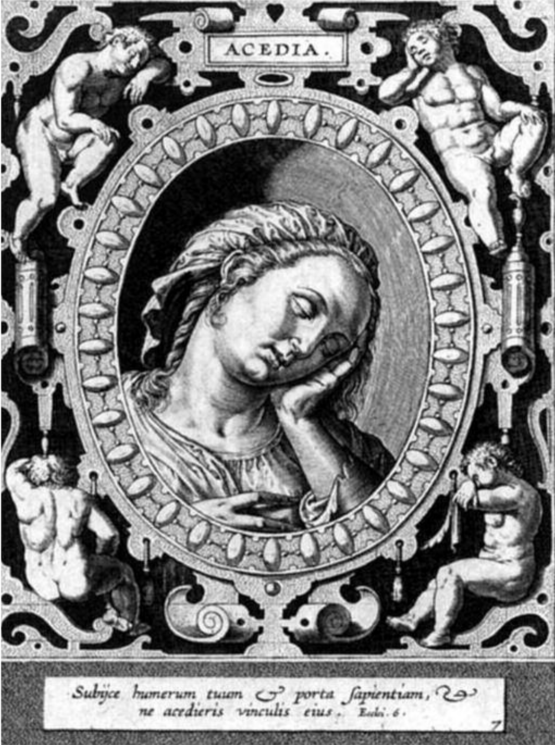
The defeat of the promises of Humanism can be read in Italian painting when one places side by side The resurrection of Christ by Piero della Francesca of the San Sepolcro2 (1463-1465) and The Lamentation Over the Dead Christ (1480) by Andrea Mantegna. “Renaissance” was not used, as a term then and was only invented much later, by the French historian Jules Michelet. Representational models depict ethical relations: on one hand the hope of an evangelist Church and of a faith in Christ are depicted in Greek and Latin standards of the body and on the other a suffering Gothic model in which the body seems smashed down. Piero della Francesca died in 1492, triple year of the discovery of the New World, of the Reconquista (fall of Granada) and of the expulsion of the Jews from Spain. Less than fifteen years after these events, three seminal books for the reshaping of subjectivity in modern politics were released: The Prince by Machiavelli (1513), In Praise of Foolishness by Erasmus (1511) and Utopia by Thomas More (1516). Albert Dürer’s famous The Angel of Melancholia was engraved in 1514. Erwin Panofsky’s interpretation of this masterpiece as a self portrait of the artist (Panofsky and Klibansky 1964) also fits relatively well within this conjuncture. What is astonishing in the angel’s eyes is the absolute acuteness of the look mixed with something like disappointment and/or despair. Thomas More concludes his chapter “Of the Wars and the Religion of the Utopians” in his Utopia with the following statement that Machiavelli could have also signed: “I may rather wish for than hope after.” Hereafter, Melancholia will become a positive affect of modernity and the psychopathology per excellence of politics. Melancholia expresses clearly a distance, even secession from the power it inherited from the legacy of another important disposition of the mind in Antiquity and medieval Christianity, acedia. In order to unpack this term I hope the reader will not mind a small detour.
In Q. 35 in the Second Part of his Summa Theologica, Thomas Aquinas identifies Acedia with “the sorrow of the world” (Weltschmerz) that “worketh death” and contrasts it with that sorrow “according to God” described by St. Paul in 2 Cor. 7:10. Acedia is an affect that regards not problems of the subject with himself, or with instances of the self–unconscious and conscious for example–but problems with the entire world. In this respect it is both a matter of politics and something distinct from neurosis, verging on what Freud referred to as the characteristics of psychosis, that are beyond that which can be cured by analysis.
For Aquinas, Acedia is “sorrow about spiritual good in as much as it is a Divine good” (Aquinas 1557). It becomes a mortal sin when reason consents to man’s “flight” (fuga) from the Divine good, “on account of the flesh utterly prevailing over the spirit.” Acedia is essentially a flight from the world that eventually leads to not caring even that one does not care. It abolishes desire and hope. The ultimate expression of this is a despair that ends in suicide. Acedia is quite near sloth, laziness and a refusal to work or participate in any activity. In a way it is the utmost sin, since it despairs of the whole creation and hence of God. The modern period that starts with what we call the Renaissance has totally excised the negative connotation conferred upon the antique and medieval meaning of acedia, turning it instead into a percept close to madness but with a positive tonality. This movement affects not only the humanists of the early XVI° century. Pascal on the contrary, stands for a devaluation of all forms of activities– entertainment–that diverts man from confrontation of his nothingness compared to the infinity of God.
If melancholia does not produce the same kind of exit attitude that Acedia does–intelligence seems at its highest peak–it nevertheless conveys an impression of powerlessness in action. All the Machiavellian virtù cannot overtake unpredictable fortuna. Phillip Melanchthon on the Protestant side, along with Thomas More and Erasmus had dreamt of reconciliation between different forms of Christianity3. The three were impotent to achieve that goal and soon war erupted in Europe, which would last for more than a century. Bipolarity of power and authority, (the Prince or the Emperor and the Summum Pontifex or the Pope) then later represented as either Church or Science and Humanities, reappears as the opposition between the authority invested in the principle of the word, representation or painting and political power. The original excitement that believes in the power of words gives way to a more lucid allowance of the impotence of the clerks.
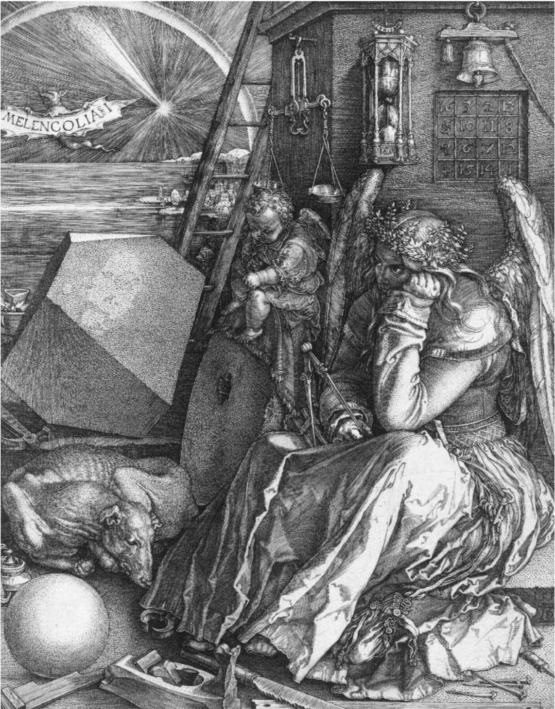
Melancholia’s bipolarity fits exactly the description of maniacal depression. Unlike Acedia, the fault does not fall any more to the person there who is inhabited by a devilish contempt of the world, but to history itself of missed opportunity (to kairos).
2. Romantic melancholia after the defeat of 1848.
Before coming to our digital epoch of “historical disease” (Nietzsche 1874) let us examine the romantic melancholia that fed subjectivity after the defeat of the Great Revolution and the 1848 upheaval in Europe. In The Contemplations (Third Book, 1856) Victor Hugo writes about Melancholia. This poem expands a sharp criticism of industrial labor but what gives it its taints of Melancholia is an acute feeling of powerlessness in front of the triumph of capitalism and the great industry.
Victor Hugo asks:
Où vont tous ces enfants dont pas un seul ne rit ?
Ces doux êtres pensifs que la fièvre maigrit ?
Ces filles de huit ans qu’on voit cheminer seules ?
Ils s’en vont travailler quinze heures sous des meules ;
Ils vont, de l’aube au soir, faire éternellement
Dans la même prison le même mouvement.
Accroupis sous les dents d’une machine sombre
Monstre hideux qui mâche on ne sait quoi dans l’ombre,
Innocents dans un bagne, anges dans un enfer,
Ils travaillent. Tout est d’airain, tout est de fer.
Jamais on ne s’arrête et jamais on ne joue.
(….)
Travail mauvais qui prend l’âge tendre en sa serre,
Qui produit la richesse en créant la misère,
Qui se sert d’un enfant ainsi que d’un outil !
Progrès dont on demande : « Où va-t-il ? Que veut-il ? »
Qui brise la jeunesse en fleur ! Qui donne, en somme,
Une âme à la machine et la retire à l’homme !
Que ce travail, haï des mères, soit maudit !
Maudit comme le vice où l’on s’abâtardit,
Maudit comme l’opprobre et comme le blasphème !
Dieu ! Qu’il soit maudit au nom du travail même,
Au nom du vrai travail, sain, fécond, généreux,
Qui fait le peuple libre et qui rend l’homme heureux !4
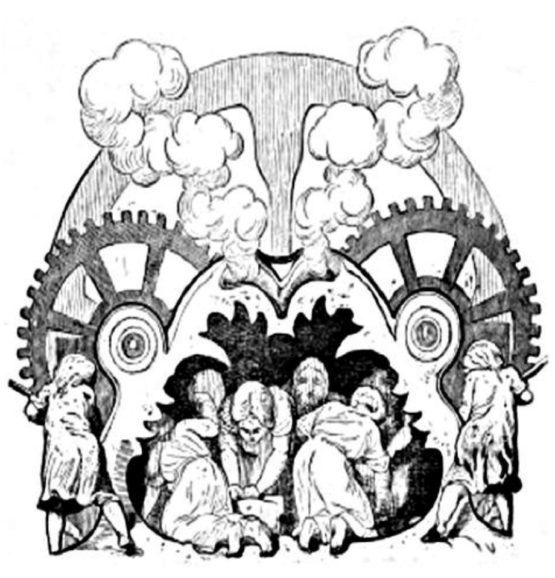
In this illustration by Pierre-Jules Hetzel it is important to notice the eyes and mouth formed in the shape of gears in a terrifying monstrous all consuming machine as well as clouds of smoke which on one hand produce connotations of a fire eating dragon but on the other the surface gyri and sulces of the two hemispheres of the brain.
3. The modern melancholia
Now we come to the modern melancholia dominated by the defeat of revolutionary communist subjectivity. Walther Benjamin and Louis Althusser represent both the failure of the project of modernity and the Bolshevik revolution. The suicide of Walter Benjamin in 1939 occurring simultaneously with the unthinkable alliance between Hitler and Stalin broke the back of any hope for victory of leftist factions exemplified in the Spanish Revolution but also in Europe. Another corner stone is the 1956 Hungarian Revolution that provided an opportunity to many communist activists, to depart without noise from their party. Louis Althusser’s psychopathic murder of his wife nine years before the final double falling down of the Berlin Wall and two years later the end of the USSR plus the bloody repression of the Chinese Spring, anticipated the end of left wing ideology as a global force. While André Gorz had said “bye bye to the Proletariat” Althusser had made a clamorous declaration at Terni and Venice in 1978 about Marxism being just bullshit and for the first time in his life adopted a public position against the French Communist Party (Althusser 1978). After the failure of the “cultural revolution” in China (1966-1976) and the absorption of the 1968 events, the manic depression of Althusser was a symbol far more spectacular of the impossibility to create a new subjectivity. Further investigation of Althusser’s biography, which he had vetoed for so long, soon revealed the cyclical character of his maniacal psychosis and its correspondence with the up and down of the political cycle. Modern negativity therefore corresponded to a process of reification beyond the figure of the grand bourgeoisie or marginal aristocrat but characterized a pathology of revolutionaries as well.
Depression has sprung from the failure of the hope of transformation of humanity, which was a throw off of the true answer to Zarathoustra’s new gospel. That is to say that the end of Man as a logical conclusion of the death of God; man’s secularity had brought him to a form of atheism in which as superman he or she became totally responsible for his actions with the full weight that that responsibility entailed. If we turn back to our present, which means from 1968 up today, we see the emergence of two conditions which promote a new hope of transformation. First the romantic hope of liberation from domination and not any more of exploitation. Communism had defined as a precondition of the new transformation a liberation that embraced quite different and sometimes opposite trends like liberation from colonialism and imperialism. Secondly the struggles of minorities against discrimination of race, gender, cast.5 During the 1960s, 1970s and 1980s these movements reached
an apex. But their capacity to disrupt capitalist order was progressively blurred by the entrance by a long term stagnation of capitalism its so called the B phase of a Kondratiev cycle—precariousness and underemployment. Instead of reunifying the working class something quite the opposite occurred; a splintering and segmentation of it occurred resulting in a phase of self-reflexive inquiry into questions concerning what defined work and the working class began popping up. That is to say that ognitive capitalism adds a new difference between the creative classes beyond their material differences instead substituting, it, as Bernard Stiegler has pointed out, with differences in access to knowledge (Stiegler 2004).6
4. Post modern melancholia?
From 1985 to the present day we have entered a new era for subjectivity. The fast expansion of information and communication technologies has stimulated the constituency of a homo numericus within cognitive capitalism very different then the New Man promised by the Maoist Cultural Revolution. This great transformation of economic value, organization of work and of capitalism as a global and pervasive and intrusive system (Boutang 2012) was not only an “objective transformation” of the economic infrastructure, but also a mutation of work: without which such transformation would not have been possible. The entrenchment between private appropriation of surplus value of activity in general as a social and global result (and not only of waged work) and free access platforms, what can be called “communism of capital,” has fostered rational and utopian hope for liberation of man through collective intelligence, contributory economy, free software, peer to peer economy, wiki platforms, crowdfunding for social entrepreneurship etc. Among researchers, political activists, ‘geeks’ and hactivists in the decade between 2003 and 2013, a vivid and somewhat fierce debate began between optimistic versus pessimistic analysis. I must confess that by psychological disposition of mind, I have never been melancholic or Saturnian. Therefore I was soon classified as an apologist of cognitive capitalism verging dangerously to indulgence towards a new kind of Saint-Simonism, what Matteo Pasquinelli has criticized as the “Californian digitalism” (Pasquinelli 2008) who was supporting diabolic Gaffa [Google, Amazon, Facebook and Apple] against the old material industrial capitalism. Beside psychological considerations, standing for a deliberate optimism of the reason, and not of the will, I persist and sign on for political reasons. For example, towards a Marxist and the operaist tradition, to which I owe a great part of my education, I retain only useful passions that increase the conatus and joyful passions.
The great melancholy of Dürer as well as its modern form of maniac depressive psychosis do not provide any help for a reconstruction of a revolutionary subject, on the contrary, it reveals quite accurately disappointment and disillusionment of a given period of history. No doubt that many hopes of transformation of society and flight of capitalism were lured, to quote Stefan Sweig, to its Confusion of Feelings (1927), “Being itself beauty, youth has no need of transfiguration. In the superabundance of its vital forces, it is allured by the tragic and in its inexperience, is prone to accept the embraces of melancholy.” The French translation of German is still more evocative, reading, “The Youth […] is inclined to be allowed to be sucked the lifeblood out of by the melancholy.”
Should we describe the golden age of the web and the spell that has followed the discovery of the creative power of the multitudes and the raising contributory economy of Wikipedia as the hypo maniac phase of hacktivism and expect the B phase of depression? A sort of Kondratiev of the mind? I am not sure. I suspect more that the tale of psychopathology or psychosis to be a self-fulfilling prophecy. The more you indulge in melancholy the more you become melancholic, and with the assistance of medical institutions today you soon will finish a kind of psychotic, mysteriously linked to the low part of the curve of political mood. To this dominant story in the Western mind of Revolution, I would oppose another story or tale of a sort of pharmacon (drug, remedy and poison): the flight or exodus in the quilombos during the first capitalism (slavish mercantilism) and the lesson that can be drawn for our present disease.
5. Quilombos in the History and Old Commons
Utopia was but a book and Thomas More finished beheaded in 1535 (canonized four hundred years after by the Roman Catholic Church as saint for political leaders). Attempts of concrete utopias as “the aspiration to a society of justice” (A. Colombo) ended in medieval and modern Europa in the burning fire for witches and those found guilty of various heresies. These dismal events were another additional source of melancholia together with the three aborted revolutions (the English, the French and the Russian ones).
However, outside European tradition, we encounter in the New World an historical tradition that has transformed flight and exit into truly liberated territories: quilombos (Brazil) or palenques, in Spanish Latin America. Most of the inhabitants of quilombos (called quilombolados) were runaway African slaves. Sometimes these escaped African slaves have been sheltered themselves by other minorities of marginalized descent such as Portuguese, Jews and Amerindians. The Quilombo dos Palmares was a self-sustaining republic of escaped slaves from the Portuguese settlements in Brazil, “a region perhaps the size of Portugal in the hinterland of Bahia” (Braudel 1984, 390). More than 2,100 quilombos were identified under colonial Brazil. Exit was the reaction of slaves to their capture and transportation from Africa, as well as a reaction to the exploitation in the plantations. In fact it was also a true agrarian revolution because by so doing, run away slaves occupied the humid forest (mata) and the fertile land growing sugar cane. Open and claimed secessions were not the only forms of these liberated zones. Less studied and more successful in the long run were the urban quilombos inside Recife that have created the model of informal employment and the favelas. Although quilombos had been receding during the 19th century with the increase of European immigration, it created a real means through which individuals gained access to land, through what was called usucapio (capture of property by continuous usus and fructus).
So succesful were these ventures that Lula’s second government introduced a ‘right to reparation’for the descendants of quilombolados that had been expelled by landlords of European small colons of the XIX and XX centuries who become successful farmers. These territories were innovative: they exchanged with the rest of Brazil. Beekeeping provided the first food, soon becoming part of more elaborated foods which were sold outside of the quilombos to get access to powder, arms even if little metallurgy was practised (Dirceu 2011). These former slaves from Benin were excellent at extracting and purifying gold and by the way they even consulted the Portuguese King on how to not to be cheated on the value of coins.
What is fascinating is that in these quilombos experiments, in order to survive, these former slaves created new forms and systems for the social division of work that relied upon polyandry consisting of structures of habitation with the woman and mothers leading to family structures which allotted lands to men through very sophisticated rules for cultivation. A man who was not fulfilling his tasks was deprived from the use of the land and naturally he had no right to appropriate the surplus. Departing from Harold Demsetzr’s superficial analysis of the use of land by Hudson Bay Indian tribes, that gave birth to the legend of the “tragedy of commons,” Elinor Oström has demonstrated that governance of trespassing, access, usus, fructus–with no private abusus, definitive transfer of property rights but provisory concession to a group or community–was and is still a much better way to manage complex ecologic systems, for example, administering limited fish resources. One could produce from the quilombos experience a theorem: the higher the degree of flight from dependant labor, the deeper auto-organization, the wiser, more sound and sustainable the governance of the famous population/resources problem. Its opposite, centralization through the State, as well as decentralization by market tools, had proved very destructive of the environment.
For how political and social structures arise in regards to private property management and interest is quite obvious. As far as public good and the State are concerned this result is less evident. However as H. Heller has shown in 2002, state property without any community to enforce intelligent use of land and natural and cultural resources has been proven to create “a disaster of the uncommons.” The cases of America, Australia, Brazil, Canada, i.e. all countries where an aboriginal population, was scattered and/or destroyed by European colonials is instructive in this regard.
6. Our news Quilombos and future of the Commons
Now moving on to digital and post industrial capitalism the question arises, how are exit spaces for subjectivity configured in our developed and already industrialised world? A world in which information and knowledge are not scarce although some scarcity could be maintained artificially? Has not science and technology gone far beyond traditional knowledge and old Commons?
We suggested above that bitterness or melancholia as a peculiar modern affect, the feeling of ineffectiveness: the failed utopian project of a society of justice from Renaissance to Enlightening, from English Revolution to Bolshevik revolution. Melancholia was also about codification of human activity in the Procrustean bed of dependant labor since in a capitalist world be it mercantilist or industrial, laziness in the mind, physical refusal of work (absentee) were part of the constitution of an alternative subject. But a third component should be added from the colonial legacy: the quilombo tradition. It could assume all forms of traditional commons including escaping to the margins of Nation-States. Any movement of separation from the bitterness of mercantilist slavery was constituted by, as we noticed, the sweetness of quilombos, although they were defeated in the long run.
But what happens in the age of real subsumption of labor under capital? In the beginning of the age of the Internet a new form of liberation took place. It was not that much concerned with exploitation. Any kind of immaterial work on the Web seemed autonomous and free from the factory, the individual boss. Exploiting the muscle only brings tiredness and sometimes (for intensive sport) serotonin. Exploiting the brain (attention but also knowledge, games) requires a preliminary development and expansion of capacities. So who would care about capture of your personal data, your privacy by a hidden robot or eliminating advertising from the white page of Google? In the deluge or tsunami of data who could not feel freer to act and navigate than in the desert world of scarce goods except for “millionaires”? The Declaration of Independence by John Barlow and the first steps of disclosure of privateer property by the General Public Licence made by Richard Stallman both sounded like a truly New Age mantra with its Christian guru to whom the Anabaptist and somewhat prophetic culture had really prepared the American audience.
However very soon, by the end of the 1990s a new melancholia had arisen embedded as it was in the post-modern milieu. A melancholia or secret saudade [regret, nostalgia] erupting out of the fact that modernity was now behind us. This deep feeling sprang from a kind of disappointment. The New Continent of peer-to-peer collaboration, the realm of abundance and gratuitousness did not remain unpolluted by merchants and traders. A new kind of immaterial beekeepers appeared. They accepted host human interactivity in technological platforms from search engines to the cloud and started to put clickers at work a long time before anyone was really aware of it, so called software agents. It was, and is still very clever, since this kind of click work is not regulated by either the state or by any trade-unions and is not rewarded by any cash reimbursement. This form of industrial profit turned out to create and capture a gigantic amount of positive externalities.
In few words we assisted in the rise of massive primitive accumulation of cognitive capitalism (Boutang 2012). Non standard historians, and economists,, including the group Midnight Notes (G. Caffentsis, S. Federici) who were born from the Review Zero Work on the end of the 1970, soon followed with documented analysis (M. Rediker, P. Linebaugh, J.W. Scott, S. Federici, E.P. Tompson) returned to the historical antecedents to discover the defeat of surging antagonistic subjects (pirates, witches, thieves, smugglers and poachers) in order to confront the birth of absolutism and primitive accumulation (XVI-XVIII). Massimo de Angelis in his 2007 The Beginning of History: Value, Struggle and Global Capital, has drawn a parallel between the actual situation and this key period for the setting of conditions of capitalism. The great tale of this desperate fight is supposed to infuse an optic of kinetic resistance, rebellion, revolt the episodes of which are only dedicated to slowing the pace of the race toward ubiquitous capitalism, even if it is in vain, at the end of the road. In such a perspective, the existence of free spaces on the Web will not last since they have already been colonized and the hypothesis of a massive expropriation of the virtual quilombos be it by the big Gaffa and the little dragons or with the tidying by the state as shown by the various attempts of Hadopi, Lopsi, Acta is considered as inescapable; a powerful factor of discouragement and melancholy. But is that the whole story? What period of history shall we choose to understand our times? The late period of Parliamentary enclosures(XVII’-XVIII’) or the period of the deserted village?7 The destruction of piracy in the Caribbean by the end of the XVI’? Or the Magna Carta moment (Lindebaugh 2009)? What is annoying in this history of the big disaster of the victory of capital is that it puts aside or neglects a completely different hypothesis: that flight and fight have had a much more decisive impact on capitalism than we tend to imagine. That is to say the resistance was not in vain because it has transformed and shaped deeply the kind of capitalism that resuletd from this antagonism. In intercultural and transculturation models the relation modifies both workers and capitalists (Ortiz 1942). Continuous flight and fights (Exit and Voice) achieve radical transformation. This was the precious legacy of Tronti’s book Operai e Capitale, a true Copernican revolution in matter of constituency of capitalism as an historical process and capital as a unstable relationship and not a thing.
7. Raiders, privateers, piracy, trade in the primitive accumulation of the third capitalism
The battle about new enclosures is rather confused. Those who were pirates (Pirate Bay), hackers, crackers soon discovered that capitalist are also privateers. For more information on this subject we can look at the analysis of biopiracy by Vandana Shiva and her fight against it. Matteo Pasquinelli has introduced the concept of parasite to characterize cognitive capitalism (Pasquinelli 2008). However the technicalities of viruses have been invented by developers. On the other hand, privateer as rent seeker of human activity and not only of wage labor could be a good definition of Web 2.0. devices.
With the capitalist use of Web 2.0 techniques of traceability of human interaction (from Google through to social networks) leisure, alternative consuming, dreaming of Art, independence of science, activity as time outside the grid, sociality, emotions, are not quilombos but more similar to Jesuit reductions facing the new Bandeirantes.8 Nowadays, the fablabs, the digital canteens, are haunted by head-hunters. The incubators of start-up get invitations from big companies to join them or share their ideas with them most of the time for a dish of lenses. Does this picture necessarily indulge in melancholia?
This new melancholia as it was first discovered by the Frankfurt school concerned how the media and communication industry, subsumed the entire society and was described in the “situationniste société du spectacle” from Guy Debord to Jean Baudrillard (Debord 1995 and Baudrillard 1987). Now we have a digital department of the Frankfurt School. Sometimes this consciousness or fear of an already announced defeat brings social activists to retreat or flight in anti-stress techniques like new age literature.
Sometimes it falls into rage, a “no future” hatred syndrome self-enclosed in more and more isolated ghettos for radicals, something little more effective than confinement in a mental ward. But has this ghetto something in common with the antic quilombos? I shall say that this attempt of secession was never achieved. The state of slavery in the real and juridical world has the advantage of being really overpassed. The symbolic and virtual slavery or alienation is much more difficult to suppress.
8. A little detour: Cognitive capitalism as capture of intangibles 2
Cognitive capitalism in the age of digital networks and technologies of information and communication is a new interacting system—not a structure—for capturing economic value. Value can be globally defined as the capture of any positive externality or avoiding the compensation of negative externalities, for any private agent, or state. It springs from production, but production is not anymore production of commodities by the means of commodities. It is bio production of life and biosphere produced by relations and only through circulation. It is also accumulation of living activity remaining alive in the consumption of resources (Boutang 2011). What is accumulated is knowledge acting and living and not dead knowledge, or codified knowledge that does not produce positive externalities. Hence value is seriously different from Marx’s definition of exploitation when he faced mercantilism and the fast rising fabric capitalism.
To extract economic value from human interactivity that I call human pollination,9 the third capitalism or cognitive capitalism must get through Caudine Forks, or as we might refer to them as the new contradictions of the “materialist dialectic.” Firstly one must keep human activity and labor as living hence develop the brain in a body at a level that was anticipated by Marx as only reachable in the communist phase as described in the Grundrisse, i.e. as a general and common intellect equipped by digital technology and linked by networks. Controlling this “invention force” (Lazzarato 2010) is much more complicated than the former proletarianization. There is the necessity of taming this new force to perform adequately. Depriving the labor force from its means of production has not been an easy task. All the violence of primitive accumulation was needed. The old commons was not a geographical margin for the expansion of a sort of gas capitalism occupying all the space available. The space was not available; it was already occupied and defended. Taming the just freed serfs and peasants and fixing them by putting them to work in factories took four hundred years. And the most difficult was to reshape, reformate their minds and the subjectivity. Humiliating the poor in European society, and through the extraction of absolute surplus value, enslaving huge part of the new labor force as was done by the market helped by the absolute Nation State.
Primitive accumulation of cognitive capitalism however is a much more complicated task. Subjection of the forces of invention needs to compete with an unavoidable condition; that of extracting value from the living. A much higher degree of liberty and socialisation is required if you want to capture innovation and collective intelligence which is by far the most valuable and hegemonic part of value today.
In order to crop positive, externalities cognitive capitalism must extend the margins of liberty, destroy the wall of the old fabric, empower society and encourage many “hundred flowers campaigns” like those of Mao.10 Communism of capital, this capital not the old industrial one, means only that the bases of exploitation now include quilombos with- out destroying them. It needs the creativity of digital quilombos, innovation distributed in society and not their reduction to melancholic boarders in mental wards. When profit depends on crowd sourcing, crowd design, cloud computing the apparatus of control and discipline is not for expanding generalized melancholia in which the possibility of the end of work might be its conclusion. No, the most used tool is now the apparatus of burn out. A continuous although non-linear praise of the expense of the brain in cooperation and care networks “à la Georges Bataille” in a permanent potlatch! (Bataille 1933) But do not think that the flight towards the shadow kingdom of melancholia has the same virtue than the one of Dürer. Nervous breakdown and permanent stress are the true pathology.
What are the objective limits to the control of the brain under a regime of cognitive capitalism?
The first one regards codification of positive externalities by transforming them into knowledge or information goods and then into quasi-public goods. Commonly produced goods and producers and consumers are more and more reluctant to produce, use and consume through the market inasmuch as they are more and more complex and inter dependant.
The commoditization of incorporated knowledge, science and technology into products and services was achieved through juridical and artificial conventions palliating indivisibility, non-rivalry and non transferability and difficulties to copy. So cheating was difficult and traceable. The revolution of the information and communication new technologies has destroyed easy and durable enforcement of intellectual property rights. Digital Rights Management has been a failure and a constant battle Cognitive capitalism meets another difficulty: trespassing IPR has devaluated their prices and the kind of externalities most valuable are related intangibles that cannot be codified, meaning care, learning, attention, intelligence in act, competence, cooperation, trust, tolerance, love. Even if you measure it (for example, the audience of a book, of reputation) it is too fickle a phenomenon to be able to predict or produce it. There is no manual for making a best-seller. Uncertainty is systemic. The solution found by cognitive capitalism is to capture the traces of interaction, personal data, through Web 2.0 arrangements, such as search engines, platforms for cooperation, innovation, and social networks.
But this is raising now a great political debate about personal data, privacy, digital citizenship and cyber liberties. Good morning for a new cycle of struggles on the rights of the cybercitizen. The quilombo cannot be attacked by armies and reduced unless cognitive capitalism decides to trade off its internal platform and new fabric for an imaginary political order achieved through counterevolution. For the time being, he has two big problems with material and industrial capitalism just like the later had problems with the slavish mercantilism. I see no internal reasons why cognitive capitalism will commit suicide. The liberation process is at the same time too big, as the absolute condition of wealth, and too feeble (the quilombo has not reach the maturity of getting rid of which the reign of scarcity).
New commons are the fundamental condition for the survival of capitalism under its new avatar. Promotion, extension and protection of the news digital commons should make profit of the experience of the old commons.
Let us take the experience of the terra nullius principle that has destroyed the ancient commons. Open source and public domain promoting the end of all copyrights but also unlimited supply of positives externalities for market activities are a sort of modern “terra nullius.” To avoid depressive exhaustion of the resources of the mind in networks some new rules of protection of collective knowledge should be instituted on the basis of creative commons (Boutang 2010). These rules cannot exclusively rely upon public and state policies, inasmuch states through private/public partnership very often are preparing old and new commons to a privatization.
Let us ask the thorny question: “Is cognitive capitalism still capitalism?” It seems that answering “yes,” we will be brought back to the revolving failure that has fed melancholia and various forms of psychopathology of the revolutionary mind since the Renaissance. I believe that the new great transformation of capitalism into its third regime and dispositif is creating new margins of liberty at the very moment it tries to block its commonism. Remember how the Wall Street Journal that had praised Empire, wasreluctant to praise the Multitude and enraged with how Commonwealth’s authors treated “cattivi maestri” [bad masters]. On the one hand cognitive capitalism promotes free access, interaction, pollination, in a certain way similar to the way communism or digital commoners in the virtual world do. On the other hand, it re-enforces IPR and captures intangibles.
By so doing, as soon as it makes more visible the huge productivity of human interaction free to pollinate it recreates tools of control at a meta-level in the cloud. The modern question of the enclosures will have to face the question of the property rights (i.e. the modalities of appropriation) of big data. Naturally, creative labor and cognitive labor stands less and less for old forms of hierarchies and promotes distributed non-hierarchical forms through the web instruments of direct democracy of Wiki politics which I have explored elsewhere (Boutang 2011). To what extent will cognitive capitalism open a fork in the road, rerouting the organization of society, will depend on conflicts about the space of liberty.
Richard Stallman has fought against the Open Source movement in late 1995. Open source is not copyleft. It allows cognitive capitalism to use positive externalities without any limitation, nor reconstitution of them. The same has to be done for open data. Open knowledge must achieve a sustainable model of production, consumption and circulation of intangibles 2.
What would need to be avoided is precisely reducing externalities and intangibles to cash machine like it as has been done in the brutal management of universities as if they were mills of old capitalism, while cognitive capitalism is trying to mimicry the academy and peer to peer evaluation processes. The second mistake to avoid is reducing intangibles, non-codified knowledge, intangibles 2 to codified intangibles 1 like evaluating everything through quantitative indexes computed in Excel tables. Such is the prescription that I would formulate to handle the psychopathologies of the cognitive capitalism. Digital quilombos do not need mental homes for maniac depressive psychosis, let us leave that kind of horrible medicine to industrial capitalist. Don’t cry, don’t smile, just understand as Spinoza used to say.11
Bilbiography
Althusser, Louis, 1978. Ce Qui ne Peut Plus Durer Dans le Parti Communiste. Paris: Maspéro.
Aquinatis, S. Thomae, 1557. Quaestiones Disputatae, De Malo, Quaestio 11, De Acedia. Et habet articulos Quatuor. S.C. Selner-Wright (trans.) Washington: The Catholic University of America Press (2011).
Bataille, Georges, 1949. La Part Maudite précedé de La Notion de Dépense. Paris: Minuit (2011).
Baudrillard, Jean, 1990. Cool Memories. London: Verso.
Debord, Guy, 1995. The Society of the Spectacle. New York: Zone Books.
Hirschman, Albert O., 1970. Exit, Voice and Loyalty, Responses to Decline in Firms, Organizations, and States. Cambridge: Harvard University Press.
Lazzarato, Maurizio, 2002. Puissances de l’Invention. La Psychologie Économique de Gabriel Tarde Contre l’Économie Politique. France: Les Empêcheurs de Penser en Rond.
Moulier Boutang, Yann (September 2001). “Marx in Kalifornien: Der dritte Kapitalismus und die Alte Politische Ökonomie” in Marx en Californie : le Troisième Capitalisme et la Vieille Économie Politique, Communication au Congrès Marx International III, Section Économie. Available online: http://www.bpb.de/publikationen/98BOPR0,0,Marx_in_Kalifornien:_Der_dritte_Kapitalismus_und_die_alte_politische_%d6konomie.html Aus Politik und Zeitgeschichte [last accessed April 2014].
Nietzsche, Friedrich, 1873. On the Use and Abuse of History. New York: Cosimo (2005).
Spinoza, Baruch, 1677. Tractatus Politicus. London: A. H. Gosset (1883).
Stiegler, Bernard, 2004. De la Misère Symbolique. Paris: Galilée.
- For further reading on this point see my book from 1998, From slavery to wage labour (PUF, Paris), which has been released in English by Brill, Netherlands. In a second moment we try to characterize the historical experience of the Brazilian quilombos and the old Commons destroyed in the late XVII-XVIII by the enclosures.
- The most beautiful painting in the world according to Aldous Huxley. Albert Camus writes in Noces (1938), “C’est sur ce balancement qu’il faudrait s’arrêter, singulier instant où la spiritualité répudie la morale, où le bonheur naît de l’absence d’espoir, où l’esprit trouve sa raison dans le corps. S’il est vrai que toute vérité porte en elle son amertume, il est aussi vrai que toute négation contient une floraison de ‘oui.’ Et ce chant d’amour sans espoir qui naît de la contemplation peut aussi figurer la plus efficace des règles d’action: au sortir du tombeau, le Christ ressuscitant de Piero della Francesca n’a pas un regard d’homme. Rien d’heureux n’est peint sur son visage – mais seulement une grandeur farouche et sans âme, que je ne puis m’empêcher de prendre pour une résolution à vivre. Car le sage comme l’idiot exprime peu.”
- Philipp Melanchthon who had written great part of the Augsbourg Confession (1530) was soon accused of weakness, indecision and melancholia (black tempered). The moment was the apex of the financial crisis of the Roman Catholic Church after the failure of the last of the kind of derivative products (trade in Relics/traffic in Indulgences and Purgatory) trying to convert in cash (works) the Christian faith.
- Where do these children go for whom nobody laughs?
These sweet, pensive beings wasted away by fever?
These eight year-old girls you see walking alone?
They go to work – fifteen hours in the mill;
They go from dawn to dusk, eternally repeating
The same motions in the same prison.
Stooped beneath the teech of a somber machine,
A hideous monster that chews who-knows-what in the shadows,
Innocents on the chain gang, angels in some hell,
They work. All is bronze, all is iron.
Never do they stop and never do they play.
(…)
Evil work that takes tender youth in its grasp,
That produces wealth by creating misery,
That uses a child like one more tool!
Progress of which we ask: “Where are you going? What do you
want?”
That breaks youth in bloom! that gives, in sum,
A soul to a machine and yanks it from a man!
That this work, hated by mothers, be cursed!
Cursed as a degenerative vice!
Cursed as damnable, cursed as blasphemy!
O God! be it cursed even in the name of work,
In the name of true work, healthy, fecund, generous,
That makes the people free and makes man happy! - For further information on this subject please see Frantz Fanon’s Essays, Toward the African Revolution: Political Essays (1969), The Wretched of the Earth (1961) and Che Guevara’s Radical Writings on Guerrilla Warfare, Politics and Revolution.
- See B. Stiegler’s, “Proletarisation: La prolétarisation est, d’une manière générale, ce qui consiste à priver un sujet (producteur, consommateur, concepteur) de ses savoirs (savoir-faire, savoir-vivre, savoir concevoir et théoriser)” available online: http://arsindustrialis.org/prolétarisation [last accessed April 2014].
- For further information on this point I discuss it in my book From Slavery to Salariate (1998).
- Bandeirantes were soldiers and mercenaries raiders employed by the Brazilian planters to capture new slaves or to get back the run away slaves.
- For further information see my own book L’abeille et l’économiste, Paris: Carnets Nord, 2010.
- Between February and April, 1957 Chairman Mao launched the Hundred Flowers Campaign.
- As Baruch Spinoza wrote in Tractatus Politicus (1677), “non ridere, non lugere, neque detestari, sed intelligere” [not to laugh, not to weep, not to curse, but to understand].