Machine-Fictioning Neuroculture: Methods for Critiquing Neuroscientific Interventions in Art and Philosophy
Introduction: Putting the Neuron to Work
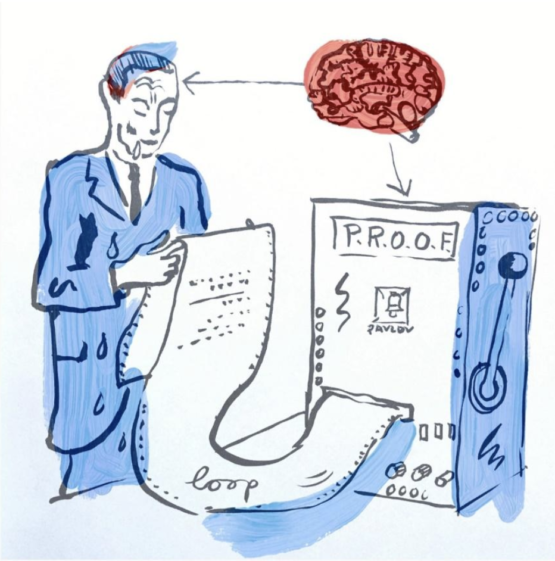
Back in December 2016, the University of Minnesota Press published my critical theory book, The Assemblage Brain.1 Taking its theoretical lead from Gabriel Tarde and Gilles Deleuze, both of whom give precedence to the affective, relational aspects of brains in their work, the book attempts to critically unpack the relation between capitalism and the neurosciences. In short, this is a relation that can be mapped on a trajectory from initial interest in brain anatomy and functionality to eventual interventions in neuronal processes. The discussion begins by positioning the origins of the neurosciences in Santiago Ramón y Cajal’s significant contribution to brain anatomy in the late 1800s and subsequent debates about the functionality of neurons. Thereafter, the focal point settles on contemporary neuroscientific interventions into a wide range of nonmedical arenas. Along these lines, The Assemblage Brain develops a new critical theory of neuroculture. This is a proliferating culture that includes, on the one hand, specific applications of theories and methods inspired by neuroscience to digital work and marketing practices, and, on the other hand, an attempt to widen the remit of neuroscientific ideas to intervene, and potentially occupy, the fields of aesthetics and philosophy.
Neuroculture is defined by neuroscientific-inspired managerial interventions and business thinking related to labor and consumption. That is to say, it is a cumulative brain culture, which starts fairly innocuously with Cajal’s anatomical drawings before eventually entering into the transformative cultural circuits of capitalism. These circuits have previously been defined as a “discursive apparatus” that is, “comprised of business schools, management consultants, management gurus, and related media that functions to constantly critique and therefore refine capitalism through generating new theories about it.”2 It is in this kind of generative theorization of capital that the brain, or more specifically, the neuron and its non-reticulate synaptic connectivity with the environment, is increasingly grasped as a flexible unit of labor, ripe for intervention.3 Certainly, running parallel to an expansion of post-Taylorism in the digital age, the interventions of neuroculture offer new ways of ridding the workplace (and shopping mall) of the evils of inefficiency by putting the neuron to work.
The generation of new neuroscientific theories of capitalism can be traced to two different models of the brain: rationalist cognitive models and more recent models garnered from affective neuroscience. Firstly, the theory follows a fairly long history of rationalist interventions in the workplace, whereby the alignment between human brains and systems of logical reasoning, like those established in the organizing systems of information technology (IT), are commonplace. Secondly, The Assemblage Brain notes that although affective neuroscience challenges the rationalist paradigm, it has also influenced the management of work and consumption based on emotional performances and efficiencies. As follows, the book traces the influence of affective neuroscience on studies of human computer interaction (HCI) as well as so-called emotional design and branding. Significantly, as part of a wider paradigm shift in approaches to the brain, affective models move on from mapping body-machine and mind-computer couplings in the workplace to a new focus on the influence implicit brain-somatic relations can have on explicit consciousness.
There are two seemingly divergent trends in the expansion of neuroculture, which are aligned to this rationalist/affective divide. The first traces a familiar concern about rationalist interventions into the arts and humanities. What this current discussion is interested in is how neuro-rationalist interventions have occurred in the field of aesthetics focused on the work of artists. To understand the nature of these interventions, this essay draws on what Gilles Deleuze and Félix Guattari call the three enunciations of philosophy, art, and science;4 which is to say, concepts, sensations (affects), and functions. Although ostensibly reductionist, and certainly not the philosophy of mixture many readers of Deleuze and Guattari will be familiar with, paying attention to these three planes of expression reveals some of the territorial blurrings that can often occur when, for example, rational science encroaches on art. Working with the theme of this edited collection, this essay will draw on these three planes to probe the discipline of neuroaesthetics.
The second trend concerns the expansive nature of the affective turn in the neurosciences. Here this discussion notes how the emotional brain thesis has opened up some clear distance between positivistic rationalist approaches.5 The problem now, it would appear, is that the old targets of critical theory (rationalist science and capitalism) have in many ways mutated into something that looks very similar to the post-humanities and its focus on affect and nonrepresentational theory. Certainly, unlike the old cognitive models of rationalism, these new models no longer consider affect, feelings, and emotions as marginal concerns. Moreover, affect has entered into the circuits of capital, becoming visible, for example, in business-focused marketing literature concerned with emotional branding.6 In short, the capitalist enterprise has been quick to realize the potential of a kind of affect theory, grasped as enmeshed in the same networks in which cognitive processes like reasoning, attention, perception, and memory reside.
As a development on The Assemblage Brain, this discussion introduces some aspects of Alfred North Whitehead’s aesthetic ontology from Process and Reality.7 This brief reading of Whitehead is intended to both counter positivistic thinking applied to the arts and critique the convergence of neuroaesthetic experience and the operations of affective capitalism. Significantly, through Whitehead’s compelling concept of aesthetic delight,8 this discussion draws on certain similarities and contrasts between the work of artists and the emotional marketers of affective capitalism. On the one hand, both are seemingly engaged in the production of often fictionalized aesthetic lures, which in various ways entice and fascinate their respective audiences through visceral appeals to implicit brain-somatic relations. On the other hand, though, evidently, the artist’s sensations have the capacity to challenge the subcritical transmissions of affective capitalism.
This essay concludes by setting out a series of Deleuzean and Whiteheadian inspired machine-fictioning methods that enable critical theory to slide in between the disciplinary boundaries of philosophy, art, and the neurosciences. And finally, through a collaboration between this author and the artist Mikey Georgeson, the article provides a link to a fictional neuroaesthetics research program. The Centre for Critical Neuroaesthetic Interferences (CCNI) is both wise to the encroachments of rational science in the arts and aware of the brain’s relation to the operations of affective capitalism.
Before exploring these two trends in neuroculture, we need to figure out what kind of brain can help us move critically between the various enunciations of science, art, and philosophy. In what follows, I begin by drawing on the approach developed in The Assemblage Brain to set out an approximate theoretical frame for the subsequent discussion.
The Brain is an Ocean
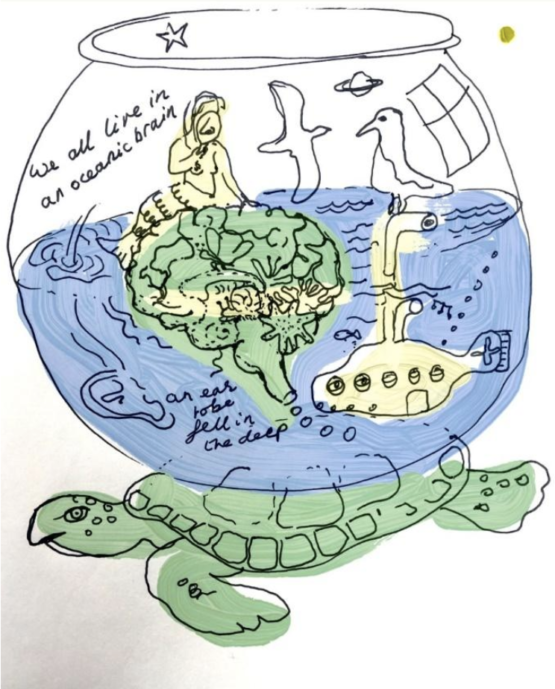
In an age of brain science mostly determined by breakthroughs in neuroimaging technology, the notion of the computer-brain metaphor is arguably untenable. Figuratively speaking, it is better to think of the brain as an ocean rather than as an information system.9 This is, indeed, a highly compelling alternative metaphor originating from theoretical neuroscience. In place of the engineering-inspired architectures of inputs and outputs, short-term and long-term memory storage, and representational encoding, the ocean brain presents an encounter with chaotic forces. In lieu of silicon circuits, the ocean brain has grey, wrinkled surfaces through which complex and fluid currents flow. These smooth, undulating surfaces are further shaped by waves stirred into action by storms as chaotic as any planetary weather system.10 To fully grasp neuroculture, it is not computer science that we need, but an oceanography of the brain.
Perhaps the chaos of the ocean brain is more than a mere metaphor. Certainly, unlike the highly abstracted analogies of cognitive neuroscience, the waves of the ocean brain point to a more definable reality in which the brain becomes related to the world. There is no visible trace of information or representation in the neuroimage, yet the affect of environmental stimuli on brainwave frequency, like those produced by sound waves, can be identified in electroencephalograph (EEG) research. By no means revealing exact cause-and-effect mechanisms, the crashing waves of sensory stimuli evidently influence the brain’s rhythmic frequencies, which, some researchers contend, relate in some way to entrainments, vigilance, and mood.11 Moreover, unlike the information channels of the cognitive brain, which supposedly connect the inner world of representation to the external world of environmental stimuli, the waveforms of the ocean brain are constructively (or destructively) displaced and distributed as intensities on an undulating surface. It is not an algorithm that relates the waves of environmental stimuli to the waves of the brain. It is the interference.
The ocean brain is not a selfdom trapped inside a black box, a computer, or, for that matter, any other object explained by engineering metaphors. In contrast to a brain that processes and stores information internally, the interferences of the ocean brain suggest a kind of physics that only knows an outside. There are no closed subjects relating to solid external objects, no continuous surfaces or straight lines running between internal and external realities: only waves. The brain is implicated in processes of subjectivity-in-the-making understood as open to the rhythmic disturbances of the outside world. The interference is indeed the brain’s encounter with chaotic external forces. This is a creative force that produces difference! In physics, for example, interferences can be looked at in very specific ways. They are, as Arkady Plotnitsky points out, “the addition or superposition of two or more waves that results in new wave patterns.”12 The interference is, as such, the interaction of waves that are correlated or coherent with each other, either because they come from the same source or because they have the same, or nearly the same, frequencies. If one has, as in music, two complex multi-periodic wave systems composed of multiple harmonics that interfere with each other, we can see a very complex resulting pattern of amplitudes in which the initial amplitudes are added and subtracted in multiple ways.13 As follows, the physics of the interference can be mapped to binaural waves in rhythmic frequency entrainments associated with affective brain states, for example.14
A broader concept of interferences can also admit the critical theorist to a speculative understanding of the relations established between different brains. For that reason, this essay borrows from the idea of the interference introduced at the end of Deleuze and Guattari’s What Is Philosophy? and considers its worth as a means by which to disrupt the seemingly discrete divisions that separate philosophy, science, and art (the three planes of enunciation). In short, three kinds of interference (extrinsic, intrinsic, and non-localized) become part of an experimental method intended to open up the many points at which the inventions of philosophers, scientists, and artists (concepts, functions, and sensations) encounter each other. Interferences can enable the critical theorist to slide between planes and enter into the chaos that traverses disciplinary boundaries.
The Virtual Work of Concepts, Functions, and Sensations
In contrast to the two cultures doctrine, which implies that the brains of artists and scientists are innately wired in very different ways,15 Deleuze and Guattari suggest various equivalences—at least, to begin with. All brains begin with a confrontation with chaos! It is the repetitive work of scientists, artists, and philosophers that produces difference. It is this work that “tear[s] open the firmament”—the figurative umbrella that shields us all from chaos—and “plunge[s]” the brain into the infinity that confronts us all.16Chaos is, in this Deleuzo-Guattarian sense, not a disorder or nothingness—chaos is the virtual. It is the void of endless possibilities the chaos brain plunges into; a world without consequence, consistency, or reference.17 The differences between science, philosophy, and art are not, therefore, simply about conflict between each discipline. On the contrary, the difference is found in the discreteness of the enunciations that follow these confrontations with chaos, which add consequences, consistency, and reference to the world. Chaos is indeed what situates the assemblage brain, making it a relational junction point between chaos and matter. It is the work of artists, scientists, and philosophers to subsequently use this junction point to cross over into the chaos and meet it head on—to return with a different articulation of the events experienced.
Concepts
The philosopher’s creation of concepts can be looked at in several ways. First, concepts are intended to retain the infinite speed of chaos and give consistency to the virtual.18 Second, concepts are heterogeneous; yet, paradoxically, they become inseparable and consistent. In this paradoxical state, the various components of a concept can become indiscernible. “There is an area ab that belongs to both a and b.”19 Third, they are relational. Concepts have components that relate and overlap. The concept is not a transcendent total; it is an assemblage. Fourth, concepts have intensive features. They are points of coincidence, condensation, and accumulation. Unlike the spatiotemporal Cartesian coordinates of science, the concept is an intensive ordinate; a value, not a point. Finally, in philosophy, the concept is not intended to form a concrete opinion. The concept is intended to surpass the finality of any so-called rational judgement.
Functions
In science, knowledge is not a value. It is a function; or rather, knowledge is made functional. Like this, knowledge is put to work as a coordinate on a graph, a correlation between variables. In cognitive neuroscience, for example, the brain function is realized through a neural correlation between brain activity, behavior, and assumed mental states. To think through how such functions of knowledge develop as variables, Peter Gaffney usefully refers to a scientific gap. Indeed, science is somewhat similar to philosophy in this context, since it also finds itself “in the gap” between the virtual and the becoming-actual (or maturing of the concrete).20 Both are thus situated within an indeterminate zone of immanence: the capacity to interrogate matter, to render signs from experimental data, is only possible by virtue of this smallest distance between a continuously renewed problem—the force of the virtual, as such—and the imminent solution (the actual).21 The scientific problem can, as such, always escape the solution. In other words, in the process of science becoming mature, the problem will tend to bifurcate and follow new lines of flight.
Can we say that science ever truly becomes mature? Significantly, the answer provided in What Is Philosophy? is that science does not find absolute unity. The new paradigm becomes no less contested than it was when immature. Nonetheless, unlike the intensities of philosophy, science is an extensive system, with references made to states of affairs and bodies. As already mentioned, neuroscience has a constant dream of capturing a bit of chaos in the neuroimage so that it becomes Nature. Like this, the neuroscientist tries to make evident the chaos into which the brain itself (as subject of knowledge) plunges. In contrast, philosophy exists outside of coordinates or correlates, in virtual neighborhoods and zones. Concepts are indeed junctions, movable bridges, or detours. Whereas science produces a series of propositions, it is the goal of virtual philosophy to refuse to become a discursive formation. Its goal is instead to expose the non-discursive—events and affects.
There are some important distinctions established between the relation philosophic concepts and scientific functives (the components of functions) have to events. Here the difference between the variations of concepts and the variable application of functions to a state of affairs becomes even more apparent. Concepts have events for consistency, whereas functives have states of affairs or mixtures for reference. So that, on the one hand, in the creation of concepts, philosophy extracts a consistent event from the state of affairs. On the other hand, science works to “actualize . . . the event in a state of affairs, thing, or body that can be referred to.”22 To reinforce this point, Deleuze and Guattari refer back to the Stoic distinction made between states of affairs, in which events are actualized, and mixtures of bodies wherein incorporeal events rise like vapor from the state of affairs.23 The difference here is found in another distinction we can make between the scientific relation established between variables (used to set a limit in the state of affairs intended to slow down the mixture of bodies) and the inseparable variations of the plane of immanence (virtuality and mixtures) that philosophy intervenes in.
Sensations (Affects)
The artist’s sensations also need to be differentiated from concepts and functions in terms of their relation to events. Take, for example, the sensations of sculptures, paintings, novels, performances, film, or music and note how they never actualize the event but instead incorporate or embody it. The sensation is, in fact, neither virtual nor actual. It is always the possible!—with a universe of possibilities in which to live. Sensations are what the artist composes with their materials, offering contemplations and enjoyments,24 but sensations also produce a universe that constructs limits, distances, proximities, and constellations.25 An artwork is, as such, a block of sensation that routes around fixed modes of perception based on resemblance and identity by putting affects and percepts into motion. Art defined in this way is not about forming a new concept or function of identity—leave that to the designers. Art is about producing varieties! Blocks of affect and percepts create new assemblages.26 As Matthew Fuller puts it, “Varieties, produced in art, are dimensions arising from the intersection of art, as it slices across the fecund turmoil of life, which partially autonomize sensation as a process of being, and through this autonomization, allow it to return with greater ferocity and passion into the world.”27
Art and Philosophy in the Shadow of Neuro-Rationalism
The generalized notion of science we are introduced to in What is Philosophy? is for the most part continuous with Deleuze’s earlier critique of rationalism in Difference and Repetition, where Descartes becomes the main antagonist. Our foil today is a related mode of rationalism that seeks to position an all-explanatory system of reason as central to a certain mode of expansive brain science.28 Why is this expansion so problematic to art and philosophy? Following the above discussion, the problem begins when we are exposed to what we might call neuro-rationalism. Herein, the possibilities of experiencing the varieties of affect in art or the conceptual variations of philosophy become blocked by the interventions of deterministic variable relations. Following the thesis in What is Philosophy?, it would seem that succeeding their encounter with the endless possibilities of the virtual, some scientists return from chaos with a resolutely two cultures worldview. Neuro-rationalism is, as such, a totalizing political project, based on a “rational social contract” that takes a Hobbesian version of human rationality as its starting point and end goal.29 One major concern is that the freedom of philosophical concepts and the sensations of art to challenge the status quo with ferocity and passion are often subsumed by rationalism. This is an expansion that is already allied to the motivations of a similarly posed rational market capitalism or neoliberalism.
Another concern surrounds a tendency of neuro-rationalism to apply brain imaging to conceptual thinking and aesthetic practices in reductive and locationist ways. As a consequence, the interferences of the chaos brain become compartmentalized in a sort of neuro-phrenology, which uses localizing technologies, like functional magnetic resonance imaging (fMRI), to draw up questionable neural-correlates between brain regions, behaviors, and mental states.30 These locationist enunciations attempt to capture the philosopher’s concepts and the sensations of the artist in coordinates on a grid. The concept and sensation thus become trapped inside a function of knowledge that can be intervened into, adapted, and made more pliable to further interventions in nonmedical arenas, like the workplace and the shopping mall. This grid-like ensnaring of the brain is linked to endeavors to produce a flexible and pliable brain, which, as Catherine Malabou contends, coincides with capitalism. That is to say, what we find is a flexible brain trapped by what Malabou describes as an ideological avatar, which obscures what it really means for a brain to be free.31
Rationalist Neuroaesthetics
A quick review of neuro-rationalist interventions into aesthetics reveals a number of familiar traits. Edmund T. Rolls’s approach to neuroaesthetics is, for instance, resolutely tied to a competitive evolutionary algorithm.32 Notably, though, this is not a solely genetically determined brain, in the strict neo-Darwinian sense. Genes adapt minds, Rolls contends, but he positions the adapted neurons in an overriding system of reasoning that maintains evolutionary homeostasis at a much faster rate than genetic variation could ever do. In other words, computational neurons are understood to be further up the evolutionary chain than the gene. It is in these highly evolved neural networks that a combination of Richard Dawkins’s meme theory and algorithmic neuroscience come into play. The brain is grasped as a vehicle for a unit of culture (analogous to a unit of nature) that determines what kind of aesthetic experience succeeds in the so-called meme pool. Rolls’s aesthetic experience is, as such, shaped by a memetic system of reason wherein emotional responses to art are forged in the stream of rewards and punishments neurons encounter and algorithmically process.33 The rewarding aesthetic experience of attractiveness in art is, in this fashion, rendered the same as the pleasurable desirability a human develops toward a potential sexual partner. Likewise, the unattractive experience of disgusting decomposing or contaminated foodstuff is correspondingly grasped as a punishing aesthetic experience. Along these binary lines, then, we might assume that, for Rolls, good art is like good sex and bad art is like a rotting maggot-infested bowl of fruit.
There are further conservative characteristics in neuroaesthetics, which are distinctly uncomfortable, it seems, with the avant-garde. Perhaps this is due to the old-school leanings of rationalist scientists who tend to exclude certain artworks from the function of beauty not just because they are punishingly ugly, but since their childlike properties are outside the canonical norm. As follows, V. S. Ramachandran’s description of neuroaesthetics argues for a need to discern between an objective version of beauty and the “dubious” imposters of conceptual art.34 Along these lines, Marcel Duchamp is presented as an absurd figure who, as any child in an art gallery can apparently see, parades himself in the emperor’s new clothes.35
Moreover, in the disciplinary crossovers between art and rational neuroscience, the search for aesthetic beauty can become subjugated to a locationist and ocular-centric regime. On the one hand, neuroscientists claim to have located the aesthetic as a function situated in specific regions of the brain: There it is, inside the brain! Beauty itself! If this function cannot be located in the neuroimage, then how can it possibly be good art? On the other hand, the eye becomes the top of the stack in the locationist hierarchy of the senses—as in, she has a good eye for art. This is because of the eye’s apparent unique relation to the brain. The neuroaesthetics program developed by neurobiologist Semir Zeki, for example, begins with the function of the cortical retina, which is the location of sight in the brain.36 The cortical retina is indeed regarded as fundamental to an ineluctable conclusion Zeki arrives at: “[The] overall function of art is an extension of the function of the brain.”37 Not only is the experience of art exclusively rendered to the “sovereign capacity of seeing” via the cortical retina, but Zeki is also keen to vaunt the giants of visual art like Michelangelo, Cézanne, Matisse, and Mondrian, and declare them as fellow seekers of knowledge about this function.38 This assumed mutuality between art and science is, it seems, part of a converging desire to grasp how real objects appear to these great artists in the same way that a neurobiologist seeks out the functions of knowledge via the cortical retina.
Like Ramachandran, Zeki’s project is typical of the neuro-rationalist’s conservative approach to aesthetic judgement. Firstly, his notion of art is pinned to archaic traditionalist ideas about high culture and Platonic ideal forms. Notably, most of the artists referred to in his study belong to a specific genre of art, too: painting. He tries to synthesize the functions of neurobiology and painting, but in doing so, makes the experience of one mode of art into a function of beauty while denying others a similar place in the canon. This brand of rational neuroaesthetics is even selective within the genre of painting itself. The Cubists, for example, are accordingly recognized as heroically attempting to mimic brain function, but not as successfully (neurobiologically speaking) as more representational artists. Vermeer is therefore celebrated for perhaps getting closer to the Platonic ideal form than Braque could ever hope to do so.39
Even when the neuroaesthetic lens moves away from the static canvas to focus on the mobiles of kinetic art, it is only to make the locationist point that the kind of mobiles Alexander Calder produced make for perfect stimuli for other brain cell regions assumed to be dedicated processors concerned with movement, not beauty.40 Likewise, there is a sharp contrast made between the parts of the brain required to process abstract art to those used to process representational art.41 What we end up with is the aforementioned manifestation of neurophrenology,42 wherein different regions of the brain are rather crudely seen as differently appreciating different genres of art. It would seem, in its search for function in beauty, that Zeki’s neuroaesthetics presents a starkly compartmentalized notion of what constitutes great art.
The locationist tendencies in rationalist neuroaesthetic programs do not account for the emergence of assemblages of art produced by collective mimetic practices. Similarly, aesthetic experience cannot be contained to localized, internal neuronal algorithms.43 On the contrary, it is the plasticity of these neuronal interactions that becomes transformed by aesthetic experiences. After all, what popular artist does not owe their success to these assemblages of affect produced by collectives of lesser-known artists experimenting with the techniques of their time. Following Gabriel Tarde’s social imitation thesis, we might say that artists imitate each other; not for evolutionary objectives alone, but rather they imitate for the sake of imitation.44 The artist copies and adapts fashionable styles and medium choices through their social affiliations to certain art movements. Art is, in this sense, not inside the brain. Art is social.
Moreover, rationalist neuroaesthetics presents an artist’s brain as devoid of explicit political reference points. An activist neuroaesthetic program would therefore need to further interrogate these problematic locationist tendencies by pointing to the political economy of the art market. We need a neuroaesthetic tool bag that can assess and challenge the art market’s influence on what constitutes great art. Critical theory needs to challenge art that is determined by powerful patronizations, permitting privileged access to an art market composed of corporate asset holdings, oligarchs on superyachts, elite galleries, and auction houses.
The Affective Turn in Brain Science
The second trend in neuroculture should be of equal concern to an activist neuroaesthetics program. It is a trend The Assemblage Brain initially framed by way of a critique of the culture-biology fissure in academia. The aim is to push the limits of what is an exhausted theoretical split that ensures that culture and biology never meet. This is a problem not contained to a split between the humanities and science alone. It is a fracture probably at its most visible in recent disputes within the humanities itself, where a thick line has been drawn between representation and discourse analysis, on the one hand, and nonrepresentational and affect theory, on the other.45 However, while acknowledging that by engaging with neuroculture there is always a risk of ushering in a deeply unsatisfactory biological determinism, it is equally important to challenge the role the humanities play as custodians of culture. This curatorial role is often pitched against the biological sciences and fends off any encroachments into a dogmatic socially constructed worldview. The Assemblage Brain argues that a critical theory of neuroculture needs to move beyond the culture-biology impasse. It needs to pose new questions concerning the emergence of subjectivity in the making, in which biological and cultural distinctions are collapsing into each other.
Despite the widespread distrust of biological explanations for social and cultural phenomena, the assumptions concerning the emergence of such things as subjectivity in the humanities are already influenced, in one way or another, by certain versions of neuroculture. On the one hand, nonrepresentational theory is often accused of haphazardly poaching from scientific knowledge to explain how certain forces bring about a relational brain-somatic subjectivity.46 The subject is never given in these accounts, since subjectivity is always in the process of becoming. On the other hand, for representational theorists, the subject is always a given. It is, after all, the subject’s brain that becomes the locus of representational (and phenomenological) analysis. Like this, representational theory remains loyal to a specific model of the brain; an equally stubborn cognitive paradigm of brain science that believes in a mind that thinks in images. In many ways, this is a similar locationist model of the brain to that already discussed. The representational brain presents a comparable model that has special access, it would seem, to a cerebral photographic album stored in memory locations. Significantly, The Assemblage Brain adopts an anti-locationist stance. To escape the biology-culture fissure, a critical theory of neuroculture needs to position itself within what Henri Bergson calls the insensible degrees between the unextended (intensive) affective state of things and the ideas and images that represent and occupy (extend) them in space.47 Along these lines, the book’s thesis forwards an ontology of intensive brain-somatic relations to the world that precede the extension of high-level conscious states.
It is important to note that this debate is in motion. It would appear that, in recent years, certain areas of the neurosciences and the humanities have effectively converged somewhere within Bergson’s insensible degrees. For instance, in his review of Catherine Malabou and Adrian Johnston’s Self and Emotional Life: Philosophy, Psychoanalysis, and Neuroscience,48 John Protevi points to a productive, if not slightly flawed, confluence of materialist continental philosophy and affective neuroscience.49 In particular, Protevi points to Malabou leaning on Antonio Damasio and Deleuze’s coinciding interest in affect and the brain.50 In a nutshell, through neuroscientists like Damasio and Joe LeDoux, an affect theory of this kind has been given some scientific cover for its creation of concepts oriented toward Spinoza rather than Descartes. This is to say, the relationship between affect theory and the brain sciences has been similarly shaped to a great extent by the shared realization of Descartes’ Error, which subsequently ushers in an all-pervasive affective turn in the 1990s.51 This turn has challenged the positivist bias toward rational thinking in computational neuroscience, focusing instead on the role feelings, affects, and emotions play in producing reason. Rather than being marginalized as noisy interferences in reasoned thinking and decision-making processes, emotions (broadly speaking) are seen as enmeshed in the very networks that lead to choices. In crude terms, I think therefore I am has been replaced by I feel therefore I am. It is at this point in the trajectory of neuroculture, where affect theory meets affective neuroscience, that critical theory must importantly reside.
The influence of Damasio and LeDoux has moved to the forefront of a far-reaching fascination with affect in the arts and (post-)humanities. For example, Damasio has a direct influence on N. Katherine Hayles’s post-humanities Unthought thesis, which draws attention to how “core consciousness” or the autobiographical self (Damasio’s term) correlates with a “cognitive nonconscious.”52 As follows, abstract thoughts, like those experienced in higher consciousness, are always grounded in somatic, affective states.53 Many other areas of the arts and humanities, including philosophy, have similarly coincided with the turn to affect, wherein certain modes of plasticity point to the potential to respond in different ways to the sensory environments a brain inhabits.54 Likewise, the so-called emotional brain thesis Damasio presents has permeated design and marketing theories and practices. For example, one well-rehearsed model in wide circulation focuses on how the brain’s sensory processing of fast affective reactions influences behavioral (motor systems) and cognitive (reflective, intellectual) responses to aesthetic experience.55 Accordingly, it is at the visceral level of brain-somatic processing of experience that higher level cognitive-economic responses, like brand affiliation and purchase intent, are supposedly triggered and accelerated.
The turn to affect significantly loosens the grip rationalism has on the neurosciences, and therefore it has also had some minor yet visible influence on neuroscientific approaches to aesthetics. For example, the Social Brain in Action Lab (SoBA) has “trained” its “scientific lens” (via fMRI technology) on the affect of dance.56 SoBA’s approach signals a move away from established neuroaesthetic fixations on “static pictures” evaluated solely by visual systems of perception. The Lab’s experiments alternatively investigate affective evaluations of dance based on “bodies moving through space” and the interactions that occur between affective processes and implicit brain action.
Affective Capitalism
A demonstrable fascination with affective neuroscience has spread to nonmedical arenas outside of academic research. Here the model of the affective brain has entered into the circuits of capital where it is beginning to exert some influence on business thinking. It is, indeed, the supposed influence emotions have on cognitive functions, such as perception, attention, memory, and decisions, that has ignited the curiosity of workplace managers and business enterprises. This is a novel neuroculture that establishes a different kind of association between capitalism and the brain, based on a malleable and implicit brain-somatic interaction. Inspired by industry gurus and business seminars espousing the emotional brain thesis, so-called experience marketers, for example, have rehearsed various ways to tap into the nonconscious brain processes of consumer experience.57
A critical theory of neuroculture needs to grasp the production of these sensory mood atmospheres in which brain-somatic relations are put to work by what has been called affective capitalism.58 This is a mode of capitalism that captures and organizes affective experiences, social relations, and desire. Unlike the rationalists, who attempt to impinge on the brain through a prescribed system of reason, affective capitalism is analogous to a Spinozan generation of value, nurtured and harvested from the capacity to affect and become affected. It is this affective capacity that is ultimately “transformed into assets, goods, services, and managerial strategies.”59 As follows, the brain’s plastic relation to sensory environments is ever more mediated through alluring manufactured experiential atmospheres designed to increase the influence implicit affects have on explicit consciousness. These pre-primed atmospheres are intended to route around cognition and appeal directly to mood. It is the production of mood atmospheres and neurological comfort zones that are intended to influence worker and consumer performances, develop emotional ties to brands, and, ultimately, drive up labor output and consumer purchase intent.
To critically approach these two trends in neuroculture, our discussion on aesthetics needs to consider what new concepts and sensations can contest the brutal judgements of the neuro-rationalists, on the one hand, while also recognizing the alluring pull of affective capitalism, on the other. The approach I propose below draws on Whitehead’s aesthetic ontology to firstly confront the rationalist measurement of aesthetic value, and secondly, consider how the sensory environments of affective capitalism can be challenged by the launch of fictionalized conceptual personae and aesthetic figures.
The Measurement of Aesthetic Fact
The existence of imaginative literature should have warned logicians that their narrow doctrine is absurd. Surely, at some point . . . , judgment is eclipsed by aesthetic delight . . . a mere lure for feeling.60
In a recent publication,61 I have sought to develop a Whiteheadian aesthetic ontology, initially intended to confront the positivist thinking Whitehead encountered while working in the field of logic. As Andrew Murphie points out, although Whitehead’s earlier work with Bertrand Russell actually promised a closed world of reason achieved through logic, math, and symbolic processing, their efforts failed to deliver.62 Perhaps it was the failure of Principia Mathematica to provide axiomatic proof of such a self-contained world that arguably led to Whitehead’s subsequent venture into speculative philosophy.63 Whatever the case, Whitehead’s philosophy would eventually look to problematize positivist efforts to expound a brutal kind of rational judgement. He would begin by arguing against the imposition of mathematical abstractions (that is, points and grids) on nature, contending instead for a kind of radical empiricism, wherein the concept of nature is experienced through the abstractions of sense data.64 What is important to note here is that Whitehead purposefully challenges the positivistic distinction made between brutal judgements and untrustworthy felt experiences. He would go on to suggestively loosen the status of fact and feeling as distinct counterparts at the polar ends of a spectrum. He argues instead for a measurement of fact founded on the intensity of experience—gauged as something he goes on to call aesthetic fact.65
We can draw a useful theoretical line here between Whitehead’s aesthetic fact and contemporary modes of positivist thinking applied in neuroaesthetics. Indeed, this reading of Whitehead renders the neuro-rationalist incursion into aesthetics quite futile. To begin with, Whitehead’s aesthetic register of experience should not be confused with personal feelings that interfere with rational judgements. What is being measured in the aesthetic fact operates on far more complex spectra of intensive and impersonal experience, with multiple polarities. We might call these abstractions of sense data spectral experiences and note how they can transverse and exceed the polar extremes of brutal judgements, on the one hand, and irrational, emotional, and illogical reasoning, on the other.
It is, indeed, the speculative nature of the aesthetic fact that unshackles the dominant grip of brutal judgement as a force opposed to visceral registers of experience. For example, on the spectra of experience, the often-forced distinction made between the beautiful and the ugly collapses into moments of utter indistinction. This does not mean that we have to deny that our experience of aesthetics can ever be felt as beautiful or ugly. Evidently, there are experiences that occupy very long durations of concrete actuality without necessarily ever virtualizing. Likewise, there are other experiences that can oscillate at various speeds between the actual and the virtual and back again. Rather crudely, then, what was once considered beautiful can become ugly . . . ad infinitum. However, making clear distinctions between such judgemental statements, as Whitehead notes, generally refuses to be “pushed to meticulous exactness.”66 To return to challenge the rationalist system of binary reason set out above, we might say that there is always the potential for beauty in that rotting bowl of fruit.
This kind of example merely points to the ludicrous ways in which aesthetic judgements are supposed to be rationally processed in neuroaesthetics. What is more important to comprehend here is the failure of neuro-rationalism to measure an aesthetic experience that exists outside of a closed system of reason. Along these lines, Whitehead provides a very different way of measuring judgement to those we encounter in neuroaesthetics. This is not a measurement based on discrete quantitative, binary values, marked out as coordinates in the closed spatial extension of a neuroimage. Beauty is not a measurable unit or rule that is on a scale from 1 to 10 or, indeed, on or off. On the contrary, aesthetic delight is a qualitative value experienced as an intensity rather than an extensity. Delight appeals to an audience on an aesthetic register of experience, occasioning what Whitehead calls a “value” based on “elements in feeling.”67 This notion of feeling is not, as positivists would have it, the polar opposite of reasoned judgement. The feeling of aesthetic delight is not necessarily a personal experience either. Significantly, Whitehead’s feelings can be broadly conceived as impersonal. Feelings are certainly not regarded, at any level, as illogical interferences in the processes of internal logical reasoning. The Whiteheadian aesthetic fact instead functions like a powerful, impersonal lure that draws an audience into the delight of an experience.
Arguably, we can also learn a lot about the lure of affective capitalism from Whitehead’s concept of aesthetic delight, since both seem to be joyful encounters that work to entice mere feeling. As follows, the experience marketers of affective capitalism can be understood to produce their own blocks of affect. The appeal of these sensations is not intended to present a ferocious challenge to the status quo; far from it. The lures of affective capitalism are more like traps! However, like the artist, who similarly produces an imaginative regime of affect, the experience marketer puts the intensity of the aesthetic into capitalism, adding sensational varieties to the world. Ultimately, critical theorists cannot measure the aesthetic delights of art or affective capitalism by way of gauging their extension in space. These mood atmospheres, these blocks of sensation, are intensities of experiences.
The Launch of a Thousand Fictioning Machines
The next part of this discussion takes its lead from Whitehead’s observation of how imaginative literature, full of fictional figures (human and nonhuman), produces the luring attraction of aesthetic delight. Through launching a series of fictional aesthetic figures and conceptual personae below, it is possible to (a), explore potential ways by which the rationalist’s incursion into aesthetics can be further challenged, and (b), provide a better understanding of the fascinating lures of affective capitalism. In this way, Whitehead’s aesthetic fact converges with the method used in The Assemblage Brain, which draws on Deleuze and Guattari’s observation (and use) of a series of fictional conceptual personae and aesthetic figures (what we will here call AFCPs) used to probe the conceptual and sensational expressions of the chaos brain. Just as scientists like Maxwell and Laplace introduce their own fictional demonic forces to express the unobservable variables between order and chaos, philosophers and artists deploy various imaginary probes, which can respectively express variation and variety in chaos.
The scientist’s demonic forces, the philosopher’s conceptual persona, and the artist’s aesthetic figure should not be mistaken for actual people. In the same way that the author of imaginative literature produces alluring fictions to express aesthetic delight, philosophers, artists, and scientists launch their own probes. In the specific context I want to use them herein, these probes are entirely fictional. The conceptual persona lives only in relation to fragmentary concepts. They are larval subjects. Through the lives of these personae, concepts are thought, perceived, and felt. The production of concepts requires these intrinsic conceptual personae to be able to make interventions. Plato used Socrates for such purposes, and Nietzsche introduced many personae: Zarathustra, Dionysus, Overman, et al. In What Is Philosophy?, the conceptual persona of the idiot is well deployed.68 The idiot is contrasted with the “Schoolman” or public teacher in the sense that he is never resigned to the facts or to historical truths.69 It is the questions asked by the idiot that unleash the creativity of the absurd, the lost, the discarded, the anomalous, and the dysfunctional. However idiotic these questions might appear to be, they create an alternative to the taught concepts of the public teacher, challenging their rationale by slowing the concept down and making it stutter. In The Assemblage Brain, I introduce the inattentive subject (the ADHD child), which is a conceptual persona that puts the “powerlessness of a political voice [back] into politics.”70 That is to say, inattentive subjects serve to make us rethink our position and ways of doing things outside of the neurotypical range.
Although at certain points in the interference between philosophy and art, concepts and sensations are kept at a resonating distance to each other, preventing their full mixture, they do go on to, at other points, develop a closer relationship. The subjectless personae of philosophy can, as follows, playfully interweave with the artist’s aesthetic figures. Just as the latter routes around opinion and fixed ideas, the aesthetic figure of the novel, painting, sculpture, or music composition produces percepts intended to surpass ordinary perceptions. Nonetheless, although we will deal with these hybrid versions (AFCPs) in this essay, significantly, aesthetic figures are not the same as conceptual personae. There are a number of differences to note. To begin with, it may be that they (conceptual personae and aesthetic figures) pass into one another, in either direction, like Stéphane Mallarmé’s Igitur and Nietzsche’s Zarathustra, but this is insofar as there are (only) sensations of concepts and concepts of sensations.71 Moreover, whereas conceptual personae take on a Promethean role, bringing concepts to life, aesthetic figures are more like vampires, looking for a body in which to live. They can only live through their percepts and affects. So, art and philosophy traverse chaos and confront it, but on very different planes. While “art thinks no less than philosophy,” it thinks through its block of sensation.72
There is a further difference between sensorial and conceptual becoming. The latter is heterogeneity grasped in an absolute form (heterogeneous consistency), whereas the former is an otherness caught in a matter of expression.73 Like science and philosophy, art therefore finds itself in the virtual-actual gap, but the block of sensation does not endeavor to actualize the virtual event. Instead, it incorporates or embodies it: it gives it a body, a life, a universe of possibilities. It provides the virtual with a figure. But let’s be clear: these figures have nothing to do with resemblance—they are the possible conditions of bringing composition to life beyond representation. Despite a commonness established between the brains of scientists, philosophers, and artists, there are distinct differences in how their experimentations sense chaos and how their thoughts and sensations become an expression of it. The commonness of the chaos brain comes about because demonic observers, conceptual personae, and aesthetic figures all partake in this enunciation of chaos.
Science, philosophy, and art are indeed similarly articulated in the sense that, as interferences, they are experimentations in thought. There is certainly no creation without experimentation, and there is as much creation in science and philosophy as there is in art. These experiments involve the launching of fictional probes into the conceptual, sensational, and functional milieu. All three probes are equidistant, as such, to chaos, and despite their creativity, they are more often than not overwhelmed by it.74 The difference here is again found in the way that science expresses the reference to a state of affairs, philosophy articulates the consistency of a concept, and art composes sensation. To this extent, the three probes we shall focus on here, Maxwell’s demon, Nietzsche’s Zarathustra, and Mallarmé’s Igitur, become sensibilia who plunge into the chaos and return as the voice of enunciation—its measurement. But amid the observations of demonic observers, the ideas of conceptual personae, and the sensation-seeking of aesthetic figures, there is an important difference in the way science, philosophy, and art articulate what they have sensed. Zarathustra does not transmit information back from the chaos. He is always already on the chaotic horizon, “circumscrib[ing] a (sympathetic or antipathetic) affect.”75 In contrast, Maxwell’s demon adopts a “point of view in things themselves that presupposes a calibration of horizons . . . slowing-downs and accelerations.”76 The demon’s perceptions therefore become a quantity of information returned from chaos, while Zarathustra turns to qualities of affect. The artist, in contrast, is always deploying aesthetic figures so as to add new varieties to the world.77 The aesthetic figure is the medium through which the artist experiments with sensation, drawing the audience into a plane of composition.
Reading Whitehead’s aesthetic ontology, we might say that he presents a hybrid conceptual persona-aesthetic figure (AFCP) which becomes the measure of aesthetic fact. For example, Whitehead specifically references an audience’s aesthetic delight on experiencing an actor reading Shakespeare’s “To Be or Not to Be” speech from Hamlet as an alternative to the positivist reasoning of logicians. Of course, this medium of fiction could, in effect, relate to any kind of aesthetic figure. The aesthetic fact can be experienced in any affecting piece of art—not just painting! But it is a fiction nevertheless. These are aesthetic facts of fiction, if you like. They are comparable to what David Burrows and Simon O’Sullivan have called machine-fictioning.78 The point is, compared to the current wave of perception management provided by the dominant fictions of affective capitalism (those feely lures of experience), other fictionalized aesthetic delights can produce an intervening alternative that has both a radical and ethical charge.79 Fictionalized aesthetic figures and conceptual personae can, as such, operate as alternative enticements.
To conclude, then, in somewhat unconventional terms, this essay presents its own example of a fictioning machine. Together with the artist Mikey Georgeson, we have produced our own AFCP in the shape of an invitation to a special inaugural seminar for the Centre for Critical Neuroaesthetic Interferences (CCNI), titled “The Brain is an Ocean: An Introduction to Critical Neuroaesthetic Interferences.”
Centre for Critical Neuroaesthetic Interferences
Centre for Critical Neuroaesthetic Interferences (cut-up version)
- Tony D. Sampson, The Assemblage Brain: Sense Making in Neuroculture (Minneapolis: University of Minnesota Press, 2016).
- Noel Castree, Rob Kitchin, and Alisdair Rogers, A Dictionary of Human Geography (Oxford: Oxford University Press, 2013), 86. The concept was first elaborated in Nigel Thrift, Knowing Capitalism (London: Sage Publications, 2005), 20–93.
- Catherine Malabou, What Should We Do with Our Brain?, trans. Sebastian Rand (New York: Fordham University Press, 2008).
- Gilles Deleuze and Félix Guattari, What Is Philosophy? (London: Verso, 1994).
- Antonio Damasio, The Feeling of What Happens: Body, Emotion, and the Making of Consciousness (London: Vintage, 2000).
- See, for example, Marc Gobe, Emotional Branding: The New Paradigm for Connecting People to Brands (New York: Allworth Press, 2010).
- Alfred North Whitehead, Process and Reality: An Essay on Cosmology (New York: Free Press, 1985).
- Whitehead, Process and Reality, 185.
- Maxwell Bennett and Peter Hacker, History of Cognitive Neuroscience (Chichester: Wiley-Blackwell, 2013), 250.
- Bennett and Hacker, History of Cognitive Neuroscience.
- Gabe Turow and James D. Lane, “Binaural Beat Stimulation: Altering Vigilance and Mood States,” in Music, Science, and the Rhythmic Brain: Cultural and Clinical Implications, ed. Jonathan Berger and Gabe Turow (New York: Routledge, 2011), 122–36.
- Arkady Plotnitsky, “From Resonance to Interference: The Architecture of Concepts and the Relationships among Philosophy, Art, and Science in Deleuze and Deleuze and Guattari,” Parallax 18, no. 1 (2012): 22.
- Plotnitsky, “From Resonance to Interference,” 22.
- Turow and Lane, “Binaural Beat Stimulation,” 122–36.
- C.P. Snow, The Two Cultures and the Scientific Revolution: The Rede Lectures, 1959 (Cambridge, UK: Cambridge University Press, 1962).
- Deleuze and Guattari, What Is Philosophy?, 202.
- Deleuze and Guattari, What Is Philosophy?, 118.
- Deleuze and Guattari, What Is Philosophy?, 118.
- Deleuze and Guattari, What Is Philosophy?, 20.
- Peter Gaffney, “Introduction: Science in the Gap,” in The Force of the Virtual: Deleuze, Science, and Philosophy (Minneapolis: University of Minnesota Press, 2010), 2–7.
- Gaffney, “Introduction: Science in the Gap,” 5.
- Deleuze and Guattari, What Is Philosophy?, 126.
- Deleuze and Guattari, What Is Philosophy?, 127.
- Deleuze and Guattari, What Is Philosophy?, 212.
- Deleuze and Guattari, What Is Philosophy?, 177.
- Brian Massumi, A Shock to Thought Expression after Deleuze and Guattari (London: Routledge, 2002), 32.
- Matthew Fuller, “Art Methodologies in Media Ecology,” in Deleuze, Guattari and the Production of the New, ed. Simon O’Sullivan and Stephen Zepke (London: Continuum, 2008), 48.
- Edmund T. Rolls, Neuroculture: On the Implications of Brain Science (Oxford: Oxford University Press, 2012).
- Rolls, Neuroculture, 306.
- Robert G. Shulman, Brain Imaging: What It Can (and Cannot) Tell Us about Consciousness (Oxford: Oxford University Press, 2013), 93.
- Malabou, What Should We Do with Our Brain?, 12.
- Rolls, Neuroculture, 133.
- Rolls, Neuroculture, 245–78.
- V.S. Ramachandran, The Tell-Tale Brain: Unlocking the Mystery of Human Nature (London: Random House, 2011), 192–93.
- Ramachandran, The Tell-Tale Brain, 192–93.
- See Zeki’s profile at University College London: https://www.ucl.ac.uk/biosciences/people/semir-zeki.
- Semir Zeki, “Art and the Brain,” in Daedalus 127, no. 2 (Spring 1998): 72.
- Zeki, “Art and the Brain,” 72–73.
- Zeki, “Art and the Brain,” 85.
- Zeki, “Art and the Brain,” 94–95. Zeki’s focus on the functional movement of kinetic art in the brain seems to also ignore the fluidity of Calder’s performing aesthetic. See Marko Daniel, “Between Paris and New York: Fountains, Fluidity, Politics,” in Alexander Calder: Performing Sculpture, ed. Achim Borchardt-Hume (New Haven: Yale University Press, 2015), 52.
- Zeki, “Art and the Brain,” 96–97.
- Shulman, Brain Imaging, 93.
- Rolls, Neuroculture.
- Gabriel Tarde, Les Lois de l’imitation, étude sociologique (Paris: F. Alcan, 1895).
- Margaret Wetherell, Affect and Emotion: A New Social Science Understanding (London: Sage, 2014).
- Wetherell, Affect and Emotion.
- Henri Bergson, Matter and Memory (London: George Allen and Unwin, 1911), 52–53.
- Adrian Johnston and Catherine Malabou, Self and Emotional Life: Philosophy, Psychoanalysis, and Neuroscience (New York: Columbia University Press, 2013).
- John Protevi, “Book Review: Self and Emotional Life: Philosophy, Psychoanalysis, and Neuroscience,” Notre Dame Philosophical Reviews, July 2013, https://ndpr.nd.edu/news/self-and-emotional-life-philosophy-psychoanalysis-and-neuroscience/.
- Similarly, the link between Damasio and the New Materialist’s leaning on brain science in the post-humanities (especially affect theory) has been made by this author and N. Katherine Hayles. See N. Katherine Hayles and Tony D. Sampson, “Unthought Meets the Assemblage Brain,” Capacious: Journal for Emerging Affect Inquiry 1, no. 2 (2018): 60–84.
- Antonio Damasio, Descartes’ Error: Emotion, Reason and the Human Brain (London: Vintage, 2008).
- N. Katherine Hayles, Unthought: The Power of the Cognitive Nonconscious (Chicago, University of Chicago Press, 2019), 45.
- Hayles, Unthought, 49.
- Malabou, What Should We Do with Our Brain?
- Donald A. Norman, Emotional Design: Why We Love (or Hate) Everyday Things (New York: Basic Books, 2007).
- See, for example, the program of neuroaesthetics of dance set out at the Social Brain in Action Laboratory: https://www.soba-lab.com/research.
- Examples of influential books that draw on the emotional brain thesis include Norman, Emotional Design, 2007 and Marc Gobé, Emotional Branding: The New Paradigm for Connecting Brands to People (New York: Allworth, 2010).
- Tero Karpi et al., “Affective Capitalism: Investments and Investigations,” in Affective Capitalism special issue of ephemera: theory and politics in organisation 16, no. 4 (November 2016): 1–13.
- Karpi et al., “Affective Capitalism.”
- Whitehead, Process and Reality, 185.
- Tony D. Sampson, A Sleepwalker’s Guide to Social Media (Cambridge, UK: Polity Press, 2020).
- Andrew Murphie, “Media Alive,” keynote talk at the Affects, Interfaces, Events conference at Aarhus University in 2018, from the author’s notes. See conference website: https://aie.au.dk/aie-2018/7.
- Murphie, “Media Alive.”
- Alfred North Whitehead, The Concept of Nature: Tarner Lectures Delivered in Trinity College, November 1919 (Cambridge, UK: Cambridge University Press, 1971).
- Whitehead, Process and Reality, 179. There are similar attacks made on positivism in Alfred North Whitehead, Modes of Thought (New York: Free Press, 2010).
- Whitehead, Modes of Thought, 23.
- Whitehead, Process and Reality, 185.
- Deleuze and Guattari, What Is Philosophy?, 63–66.
- Deleuze and Guattari, What Is Philosophy?, 63.
- Michael Schillmeier, Eventful Bodies: The Cosmopolitics of Illness (Farnham: Ashgate, 2014), 43.
- Deleuze and Guattari, What Is Philosophy?, 177.
- Deleuze and Guattari, What Is Philosophy?, 66.
- Deleuze and Guattari, What Is Philosophy?, 177.
- Deleuze and Guattari, What Is Philosophy?, 127.
- Deleuze and Guattari, What Is Philosophy?, 132.
- Deleuze and Guattari, What Is Philosophy?, 132.
- Deleuze and Guattari, What Is Philosophy?, 175.
- David Burrows and Simon O’Sullivan, Fictioning: The Myth-Functions of Contemporary Art and Philosophy (Edinburgh: Edinburgh University Press, 2019).
- Simon O’Sullivan, “Mythopoesis or Fiction as Mode of Existence: Three Case Studies from Contemporary Art,” Visual Culture in Britain 18, no. 2 (2017): 292–311, https://www.simonosullivan.net/articles/Mythopoesis_or_Fiction_as_Mode_of_Existence.pdf.