Attentional World-Making, Meta-Attentional Derivatives, and Hyperstitional Ambivalence
I. Attention Economy: Captological Neuropower
Our attentional moves are world-making. Even if our existence depends upon countless relations we are unaware of (and partly insensitive to), what we consider to be “our world” takes shape and meaning for us on the basis of these aspects of our environment upon which our attention has been drawn. Our attention is in constant movement, partly due to the salience of external stimuli, partly due to internal drives and intentional efforts. These attentional moves can be considered as world-making not only because they act as the brushstrokes that paint our subjective world, but also because we act in the world according to the way we experience it.
Our attention is materialized in the electrical pulses of our expanded nervous system, extending to the outer limits of our media networks. Human attention is not only located “in the brain” but also in the whole neural network that transmits information and affections via electrical pulses crossing our individual body. In intensely mediated societies like ours, “my” attention is not only located within “my” neural system, limited by the borders of my skin. Through my eyes and ears and fingers, “my” neural system is directly connected to “our” media networks, that is, (1) to the sociotechnical apparatus collectively set in place to govern our communication with our environments, and (2) to the sets of categories and values commonly accepted to sort out information and to provide it with meaning within a certain (sub)culture. As a consequence, “my” attention is never purely personal, but always collective.1 “My” attentional moves can only be understood within the broader scope of a common system of sensibility, which is now mediated by electrical flows assembled through computational operations within a world-wide network referred to as “algorithmic governance” by Thomas Berns and Antoinette Rouvroy,2 “worldly sensitivity” by Mark B. N. Hansen,3 or “computation at a planetary scale” by Benjamin Bratton.4
In our intensely mediated societies, political power flows and coalesces according to the ways in which our mediarchies “intrastructure” our perceptions and our affects through the solicitation of our attentional moves. Rather than as “democracies” (power emanating from the people), our intensely mediated societies should be considered as mediarchies,5 where power emanates from the circulation of electrical pulses across the human bodies assembled in various types of “publics.”6 Media collapses the traditional difference between “infrastructure” (the material basis that sustains our bodily existence) and “superstructure” (the various representational constructions that reflect and attempt to rule our relations). Media acts as an intrastructure: their material (external) sociotechnical apparatuses condition and structure (from the inside) the way each of us experiences our environments. The constitution and distribution of political power among us results from the ways in which our mediarchies intrastructure our (collective and individual) world-making attentions.
At the social as well as at the individual level, mediarchical dynamics should be understood in light of the principle of neural association known as “fire together wire together.” While our collective world-making can certainly be influenced by intentional strategies,7 it unfolds mostly along a chaotic multiplicity of contiguous associations stabilized within individual and collective human nervous systems. Sigmund Freud’s principle of Bahnung (facilitating), Donald O. Hebbs’s theory of sensory association, Francisco Varela’s neural assemblies, and Joaquin Fuster’s synchronous convergence8 all attempt to explain a dynamic process, already described by Spinoza or Diderot, through which contiguous and contingent co-occurrences solidify into durable associations that pave the way for future paths of cognitive and affective development. Simply put, “Neurons wire together if they fire together.”9 This can be read as the basic building principle of all intrastructural dynamics: contiguous (salient) stimuli provided to our attention by our mediarchies tend to result in necessary associations (even if their co-occurrence may be originally contingent). This principle accounts for the wide (although not unbounded) plasticity of our collective world-making attention.
Our current dynamics of neuropower are intrastructured first and foremost through the commodification of our attention. While some of our daily communications via electronic media can still escape the pressure of the attention economy,10 most of the techno-institutional vectors (for example, media) that fuel our nervous systems with stimuli are organized along the competitive rules that originated in the 1830s, simultaneously in France, England, and the United States, when innovative press barons started to sell their daily newspapers at half the price of their production costs, making up for the difference by selling ad space to advertisers.11 What they were actually selling was their readers’ attention, which became from then on a traded commodity. Two centuries later, the commodification of our attention has become the hegemonic economic base of the form of neuropower12 within our mediarchies.
The ubiquitous commodification of attention generates a captological arms race that saturates our communications with saliences and subordinates informative content to captological potential. Since economic survival in our current mediarchies is indexed upon the agent’s capacity to attract (and monetize) attention, our communicational environment pushes emitters of messages towards the use of saliences—that is, signals that cannot remain unnoticed by our nervous system. These saliences are partly absolute, when they trigger a response from any able-bodied person (fire alarms, flashing lights, etc.), partly targeted, when online platforms analyze our data flows to predict which artist, brand, word, notification will hit one of our personal soft spots. The overall result of this captological arms race is that discourses, images, and sounds flow among us, not on the basis of their personal and collective relevance or empowering promises, but first and foremost on the basis of their potential to attract, capture, and sell our attention, with the frequent result of distracting and alienating us from more urgent or more emancipating concerns.
Neuropower and activist neuroaesthetics are bound to clash on three main battlegrounds where our neurons wire together when they fire together: saliences, habits, and vectors. The battle around saliences will determine what fires our personal and collective neural networks.13 The battle around habits will determine the wirings that result from such firings to shape our behaviors and expectations in the long run.14 The battle around vectors will determine who possesses and controls the wires through which our communications are shaped, within a new form of class struggle between the vectorialist class and the hacker class.15
II. Financial Meta-Attention: The Dynamics Of Derivatives
Human attention is in large part directed towards (other people’s) attention: it is meta-attentional. Processes of socialization teach us from the earliest age that nothing is more important to us than the attention we receive from other humans. “Joint attention” can be observed in the infant after only a dozen months of life, but most human interactions include constant attempts to adjust one’s behavior to what one interprets about the other participants’ attentional moves. When person A’s attention becomes the object of person B’s meta-attention, the original object of A’s attention tends to matter less than B’s reaction to it in the present and, even more importantly, in the future.
Surveillance capitalism is only geared towards the tracking of our attentional moves insofar as it attempts to monitor and predict our future behavior. Shoshana Zuboff’s compelling anatomy of “surveillance capitalism”16 invites us to leave aside our often fuzzy complaints about “the attention economy” in order to focus on the “behavioral surplus” which platform capitalism manages to extract from the tracking of our attentional moves. Google, Facebook, and Amazon are only interested in what we (currently and actually) pay attention to insofar as they can predict what we will be inclined to pay money for (in the future). Algorithmic governmentality should be understood as a form of meta-attentional speculation geared towards the extraction of profit from the computational analysis of our behavioral surplus.
The dynamic structure of capitalism is based upon adopting a “meta-” position in which financial derivatives only redouble at a higher level of abstraction. In the famous “general formula of capital” sketched by Marx in Capital, Money (M) is only invested in the production of Commodities (C) in order to generate a surplus of Money (M′) as the result of the commercial process (M – C – M′).17 The conquering (and ecocidal) logic of capitalism is based upon the fact that the material specificity and intrinsic properties of the commodities (C) produced in the industrial process are secondary, and only instrumental, to the extraction of profit (M′>M). When financial derivatives become the driving force of the capitalist economy (happening since the 1990s) they operate as a form of “meta-capital,” at a higher level of abstraction but along similar lines to the operations of capital conceived as a form of meta-commodity. As Randy Martin brilliantly explains, derivatives bundle together risk factors and potential opportunities that are originally unconnected, spread out within the multiple aspects of our socio-environmental realities.18 Speculators generate hypotheses of causal relations between some apparently separated phenomena; they release these hypothetical relations to be rated by competitive mechanisms in financial markets, in the form of bets taken over the variations in the value of certain “underlying assets.” Although such speculations have routinely been performed for hundreds of years—and duly criticized and denounced at least since the seventeenth century19—these bets (the “derivatives”) have tremendously grown in quantity, complexity, and importance since the 1970s.
The mass assembly line gathered all its inputs in one place to build a tightly integrated commodity that was more than the sum of its parts. Financial engineering played this process in reverse, disassembling a commodity into its constituent and variable elements and dispersing these attributes to be bundled together with the elements of other commodities of interest to a globally oriented market for risk-managed exchange. Each of these movable parts is reassembled by risk attribute so that they become worth more as derivatives than their individual commodities. . . . By abstracting capital from its own body . . . derivatives do to capital what capital itself has been doing to concrete forms of money and productive conditions such as labor, raw materials, and the physical plant.20
We could therefore supplement Marx’s formula for capitalism with a meta-formula for meta-capitalism augmented with the social logic of derivatives: Capital (C) is only invested in the heuristic of risk and opportunities in the form of Derivatives (D) in order to generate a surplus of Capital (C′) as the result of the financial process (C – D – C′).
Surveillance capitalism does to the attention economy what derivatives have been doing to capital. The meta-attentional nature of surveillance capitalism ought to be interpreted in the light of, and in parallel with, the recent developments of the social logic of derivatives conceived as a form of meta-capital. Our individual attention, directed towards a certain set of images, words, sounds, and narratives, is “disassembled into variable elements” of information. These elements can then be “dispersed” and “bundled together with the elements” of other attentional moves, tracked within the individual’s record as well as across transindividual sets of data. These datafied elements are finally “reassembled” according to advertising opportunities, so that they become worth more as attentional derivatives (behavioral surplus) than their individual commodities (a concrete and singular attentional move). By abstracting attention from its embodiment, attentional derivatives do to the attention economy what capital itself has been doing to concrete forms of money and productive conditions, and what derivatives themselves have been doing to capital. Hence a third formula, which could be used as a springboard for a whole range of analyses of neurocapitalism: Computational Knowledge (CK) is only invested in the monitoring of Attention (A) in order to generate a surplus of Commodifiable Knowledge (C′K′) as the result of the surveillance process (CK – A – C′K′). Here again, though, the conquering and ecocidal logic of capitalism with derivatives is based upon the fact that the material specificity and intrinsic properties of the human attention (A) produced in the cognitive process are secondary and only instrumental to the extraction of profit (C′>C).
The social logic of attentional derivatives could extend the tentacles of cognitive speculations towards the empowering exploration of neurodiversity, as well as towards the ecocidal greed of neurocapitalism. Derivatives are etymologically rooted in excess: a river “de-rives” when the superabundance of its water is higher than its banks (rives) and goes overboard. In other words, derivatives and drifts (dérives) are two sides of the same coin. Financial derivatives can be described (by Hayekian ideologues) as a superior form of transindividual rationality in the form of risk management, risk spreading, and risk anticipation—a superior neuropower now computationally managed by high-speed trading algorithms. Financial derivatives can be equally well described (by ideologues critical of the neoliberal ecocide) as a superior form of herd madness, leading to the blinding formation (and damaging explosion) of speculative bubbles. The social logic of attentional derivatives is currently ruinous insofar as it is geared towards, and ruled by, the commodification of our attention. Neurons are led to fire together and wire together so as to maximize the financial profit that can be extracted from their triggering, under the guidance of attentional derivatives. Neurocapitalism subjects our attention to the same extractivist exploitation it has applied to natural resources (fossil fuels) and bodily energy (manual and intellectual labor). By its very structure, financial speculation is bound to sacrifice our common welfare to the interests of (a tiny minority of large) capital investors. Nevertheless, the intrinsically “drifting” nature of (attentional and financial) derivation also makes it a potential ally in tentative explorations and experimentations in other-world-making. Speculative philosophy, speculative storytelling, and speculative art also extend tentacles, disassemble processes into variable elements, bundle them together, and reassemble them in unpredictable manners. Their madness is as interesting as their rationality. Attentional derivatives may be put to the service of neurodiverse experiences, against their current tendency to align with the extractivist goals of neurocapitalism.
III. Aesthetic Meta-Attention: Activism in Ambivalence
Many centuries before surveillance neurocapitalism started to rule our world-making attentions from the heights of its computational platforms, other modes of meta-attentional operations had already been developing in the aesthetic realm. Whenever an art form involves activities of framing, focusing, editing, composing—as is the case with poetry, tales, novels, paintings, music, or film—the creator stages not only “the content” of what is displayed but, equally importantly, the attentional gestures and choices through which this content is displayed. Whether on the part of the creator or on the part of the reader/listener/spectator, the aesthetic realm has been a vivid site of meta-attentional studies for centuries.
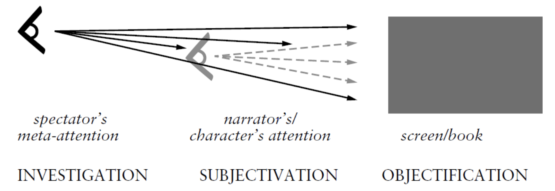
As figure 121 attempts to show, when I read a story (or when I watch a screen), the object of my attention is simultaneously—and variably—what is shown in the book (or on the screen) and the narrator’s or character’s attention through which the story or the scene is presented. Such situations are meta-attentional insofar as I pay attention to how someone else pays attention to a certain portion of reality. When we study aesthetics, we investigate the ways in which subjectivations take shape through the attentional moves performed to objectify a certain situation.
As provided through aesthetic experiences, situations of meta-attentional engagement train human subjectivities to oscillate between an insider’s perspective of immersion and an outsider’s perspective of critique. As a reader/spectator, I am led (simultaneously or alternatively) to pay attention to what is seen by the characters and to how it is seen by them. I am thus led to oscillate between two poles: one of immersion and one of critique. Such an oscillation has been well described by Jay David Bolter and Richard Grusin in Remediation through their analysis of the ways in which (new) media can modulate experiences of “immediacy” (whereby the reader/spectator feels presently immersed in a remote world) with awareness of “hypermediacy” (whereby the reader/spectator considers the framing and editing devices of the windows through which this remote world is represented).22 Figure 223 attempts to represent the meta-attentional structure of this oscillation between immersion and critique, similar to the remediating oscillation between immediacy and hypermediacy.
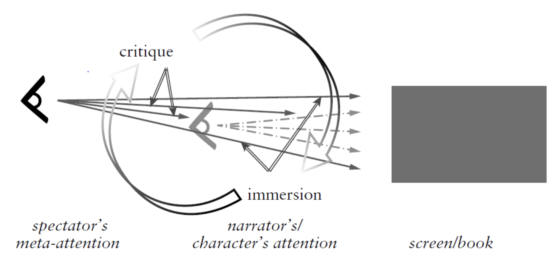
The resulting dynamics of this structural oscillation is of utter importance insofar as it pushes the reader/spectator not only to multiply his or her points of view, but to multiply the—potentially contradictory and incompatible—value systems that may be associated with these points of view.
Most artistic propositions can be included in the category of activist neuroaesthetics insofar as they provide remediating experiences that purposefully alter the intrastructure of our world-making attention. Activist neuroaesthetics are built upon the premise that, by providing sensory experiences which lead uncommon bundles of neurons to fire together, they may result in new bundles of neurons wiring together.24 Such experiences are implicitly or explicitly hoped to expand our cognitive associations: they remedy a lack of associations by re-mediating the ways through which such associations come to be. Activist neuroaesthetics thus purposefully attempt to trigger attentional moves that will alter the paths of exploration and the habits of association that intrastructure our world-making capacities.
Platform capitalism provides a contagious milieu particularly prone to develop a hyperstitional form of activist neuroaesthetics. Nick Land and his collaborators in the Cybernetic Culture Research Unit have crafted the important concept of hyperstition to explain the puzzling dynamics through which apparently “superstitious” beliefs come to precipitate into actual realities by the virtue of the “hype” that first surrounds, then carries, and ultimately actualizes them.
[Hyperstition] can be defined as the experimental (techno-)science of self-fulfilling prophecies. Superstitions are merely false beliefs, but hyperstitions—by their very existence as ideas—function causally to bring about their own reality. . . . Hyperstition can thus be understood, on the side of the subject, as a nonlinear complication of epistemology, based upon the sensitivity of the object to its postulation. . . . The hyperstitional object is no mere figment of “social construction,” but it is in a very real way “conjured” into being by the approach taken to it. . . . Capitalism incarnates hyperstitional dynamics at an unprecedented and unsurpassable level of intensity, turning mundane economic “speculation” into an effective world-historical force.25
The commodification of attention which intrastructures the mediarchy under the domination of platform capitalism tends to exacerbate the contagious dynamics of human beliefs. Since “once started, a hyperstition spreads like a virus and with unpredictable effects,”26 activist neuroaesthetics can find in hyperstitions a particularly powerful vector of alteration of our world-making capacities.
Hyperstitional activism can simultaneously profit from and counteract the social logic of attentional derivatives. By disassembling our attention into its constituent and variable elements and by dispersing these attributes to be bundled together with the elements of other attentions, derivatives are operators of dissociations and associations. By providing opportunities for previously unassociated neurons to fire together and possibly wire together, activist neuroaesthetics trigger attentional moves that pave the way for new forms of cognitive associations. When Nick Land characterizes hyperstitions as “coincidence intensifiers,” he provides one suggestive way to understand how processes of firing together can precipitate into habits of wiring together.27 Thus, a brand of activist neuroaesthetics that would mobilize the powers of hyperstitions could at the same time benefit from the highly contagious milieu provided by platform capitalism to spread in it like a virus, and counteract its logic by bundling together (sub)attentional elements along different lines than the ones oriented by the will or the need to profit from the commodification of attention. For, as Delphi Carstens insistently repeats, far from neatly aligning the world along the interests of capital accumulation, “the hyperstitional ‘infection’ brings about that which is most feared: a world spiraling out of control.”28 Hyperstitious viralities, as we have seen, come “with unpredictable effects.” In the imaginary generated around Nick Land and the CCRU, the bundling together of attentional elements and the coincidence intensifications performed by hyperstitions are factors of apocalypse, rather than vectors of profit.
The inherent power and the inherent dangers of hyperstitions force us to put their irremediable ambivalence at the very core of our understanding of activist neuroaesthetics. In her attempt to understand “what today’s counter-hegemonic culture looks like,” Caroline Busta29 remarks that “Extinction Rebellion is countercultural in spirit, but so too are QAnon, the armed right-wing libertarian Boogaloo Boys, and Europe’s “Reichsbürger”:
[We are faced with] a raging messy semiotic meltdown of radicalizing (if absurdist) meme culture where the only ideological no-go zone is the liberal center. . . . Intuiting that any activity directly opposing the system will only make the system stronger, the next generation is instead opting for radical hyperstition: constructing alternative futures that abandon our current infrastructure entirely. . . . Today’s counter-hegemonic culture [is] not particularly interested in being seen—at least not in person. . . . But it does demonstrate a hunger for freedom—freedom from the attention economy, from atomization, and the extractive logic of mainstream communication . . . and a new desire for scarcity in cultural objects.30
Activist neuroaesthetics are bound to be ambivalent about the contagious nature of their communicational actions. On the one hand, in order to have a significant impact, the success of their activism will have to be measured in proportion to their capacity to go viral within the current platforms of surveillance capitalism. On the other hand, activists know perfectly well that any form of viral success, no matter how countercultural it purports to be, “is an unwitting loyalty to the platform and, by extension, to the shareholders of Alphabet and Facebook, Inc.”31 Hyperstitions push this type of ambivalence to its extreme: their uncontrollable and unpredictable dynamics tend simultaneously and inextricably to carry radical criticism and conspiracy theories, emancipatory desires and fascistoid resentment, apocalypse in the sense of the uncovering of deeper truths and apocalypse in the sense of final destruction. This ambivalence is most strikingly illustrated by the fact that white supremacist QAnon is suspected to be the unintentional bastard son of Italian leftist media activists Wu Ming, through the best-selling novel Q published under the name of Luther Blissett.32 Hyperstitions are bound to be ambivalent because their effectivity does not rest with their subjective agent but, as we have seen, with “the sensitivity of the object to its postulation.” This (originally fictional) object can only be “‘conjured’ into being by the approach taken to it” insofar as this approach plunges into the blinding glare of immediacy. Its ambivalence is irremediable: there can be no remedy for it, since the remedy would kill the patient (the very effectiveness of the hyperstition).
One of the main tasks of activist neuroaesthetics may be to mobilize the virtues of meta-attentional aesthetics in order to help us cope with the ambivalences of hyperstitional activism. While the ambivalence inherent to hyperstitional activism can neither be mastered nor overcome, it can be experimented with and reflected upon. And this is where meta-attentional studies provide an invaluable contribution to activist neuroaesthetics. Because they train us to be simultaneously within and without, immersed and critical, in constant oscillation between immediacy and hypermediacy. Meta-attentional studies allow activist neuroaesthetics to become privileged sites for leading experimentations in ambivalence. Even if there can be no remedy to the ambivalences of hyperstitions, there can be countless ways to remediate them. And because the oscillation between immediacy and hypermediacy is constitutive of our common aesthetic experiences of (new) media, the most crucial and promising space for activist neuroaesthetics may very well be located in the investigative distance the meta-attentional aesthetic engagement allows us to take, not only from the scenes and perspectives that are objectified, but also from the subjective positions that are implied in these situations (as sketched in figure 1 above) and this distancing is bound to question and corrode our own subjective positions. As Caroline Busta cleverly suggests, “To be truly countercultural today, in a time of tech hegemony, one has to, above all, betray the platform, which may come in the form of betraying or divesting from your public online self.”33 The disassembling and re-bundling of our attentional elements practiced by surveillance capitalism (as well as by meta-attentional aesthetics and by hyperstitional activism) force us to adopt a neuro-aesthetic approach to our own self—a self which can no longer be simply imagined as a sovereign totality endowed with unified intentionality and free will. We must learn to see ourselves as embodied neural networks connected to computational neural networks, firing together and wiring together to the rhythm of common and conflictual oscillations that inextricably disassemble and re-bundle attentional moves of immediacy and hypermediacy. The ambivalence of hyperstitional activism helps us measure the deeper ambivalence of our relations to our common environments and to ourselves. Under the growing hegemony of platform capitalism, we need activist neuroaesthetics, meta-attentional oscillations, and hyperstitional dynamics to break away from the ecocidal and egocidal dynamics that currently make our world uninhabitable and our selves hardly livable.
- Charles T. Wolfe, “De-ontologizing the Brain: From the Fictional Self to the Social Brain,” CTheory 30 (2007): 1, http://www.ctheory.net/articles.aspx?id=572; Charles T. Wolfe, “Cultured Brains and the Production of Subjectivity: The Politics of Affect(s) as an Unfinished Project,” in The Psychopathologies of Cognitive Capitalism: Part Two, ed. Arne De Boever and Warren Neidich (Berlin: Archive Books, 2014).
- Thomas Berns and Antoinette Rouvroy, “Algorithmic Governmentality and Prospects of Emancipation,” Réseaux 177 (2013): 163–96.
- Mark B. N. Hansen, Feed-Forward: On the Future of Twenty-First-Century Media (Chicago: University of Chicago Press, 2014).
- Benjamin Bratton, The Stack: On Software and Sovereignty (Cambridge, MA: MIT Press, 2015).
- Yves Citton, Mediarchy (Cambridge, UK: Polity Press, 2019).
- Michael Warner, “Publics and Counterpublics,” Public Culture 14, no. 1 (2002): 49–90.
- Konrad Becker, Tactical Reality Dictionary (New York: Autonomedia, 2002); Konrad Becker, Strategic Reality Dictionary (New York: Autonomedia, 2009).
- See Warren Neidich, Glossary of Cognitive Capitalism (Berlin: Archive Books, 2020).
- Löwel and W. Singer, “Selection of Intrinsic Horizontal Connections in the Visual Cortex by Correlated Neuronal Activity,” Science 255, no. 5041 (1992): 209–12.
- Yves Citton, The Ecology of Attention (Cambridge, UK: Polity Press, 2017).
- Tim Wu, The Attention Merchants (New York: Alfred A. Knopf, 2016).
- Warren Neidich, “Neuropower: Art in the Age of Cognitive Capitalism,” in The Psychopathologies of Cognitive Capitalism: Part One, ed. Arne De Boever and Warren Neidich (Berlin: Archive Books, 2013).
- Becker, Tactical Reality Dictionary; Becker, Strategic Reality Dictionary.
- Wendy Hui Kyong Chun, Updating to Remain the Same: Habitual New Media (Cambridge, MA: MIT Press, 2016).
- McKenzie Wark, A Hacker Manifesto (Cambridge, MA: Harvard University Press, 2004); McKenzie Wark, Capitalism Is Dead: Is This Something Worse? (New York: Verso, 2019).
- Shoshana Zuboff, The Age of Surveillance Capitalism (New York: Public Affairs, 2019).
- Karl Marx, Capital, bk. 1 (Moscow: Progress, 1867).
- Randy Martin, Knowledge LTD: Toward a Social Logic of the Derivative (Philadelphia: Temple University Press, 2015). See also Dick Bryan and Mike Rafferty, Capitalism with Derivatives: A Political Economy of Financial Derivatives, Capital, and Class (New York: Palgrave Macmillan, 2006).
- Martial Poirson, Comédie et économie du classicisme aux Lumières (Paris: Classiques Garnier, 2015).
- Martin, Knowledge LTD, 61.
- Citton, The Ecology of Attention.
- Jay David Bolter and Richard Grusin, Remediation: Understanding New Media (Cambridge, MA: MIT Press, 2000).
- Citton, The Ecology of Attention.
- Warren Neidich, The Glossary of Cognitive Activism (Berlin: Archive Books, 2019).
- Nick Land, “Hyperstition: An Introduction—Interview with Delphi Carstens,” Orpha Drift Archive, 2009, http://www.orphandriftarchive.com/articles/hyperstition-an-introduction/.
- Delphi Carstens, “Hyperstition,” 2010, http://xenopraxis.net/readings/carstens_hyperstition.pdf.
- Land, “Hyperstition.”
- Carstens, “Hyperstition.”
- Caroline Busta, “The internet didn’t kill counterculture—you just won’t find it on Instagram,” Document Journal, January 14, 2021, https://www.documentjournal.com/2021/01/the-internet-didnt-kill-counterculture-you-just-wont-find-it-on-instagram/.
- Busta, “The internet didn’t kill counterculture.”
- Busta, “The internet didn’t kill counterculture.”
- Raphaële Rérolle, “Aux sources de QAnon, un collectif italien d’extrême gauche qui aurait malgré lui inspiré la théorie complotiste,” Le Monde, February 19, 2021.
- Busta, “The internet didn’t kill counterculture.”